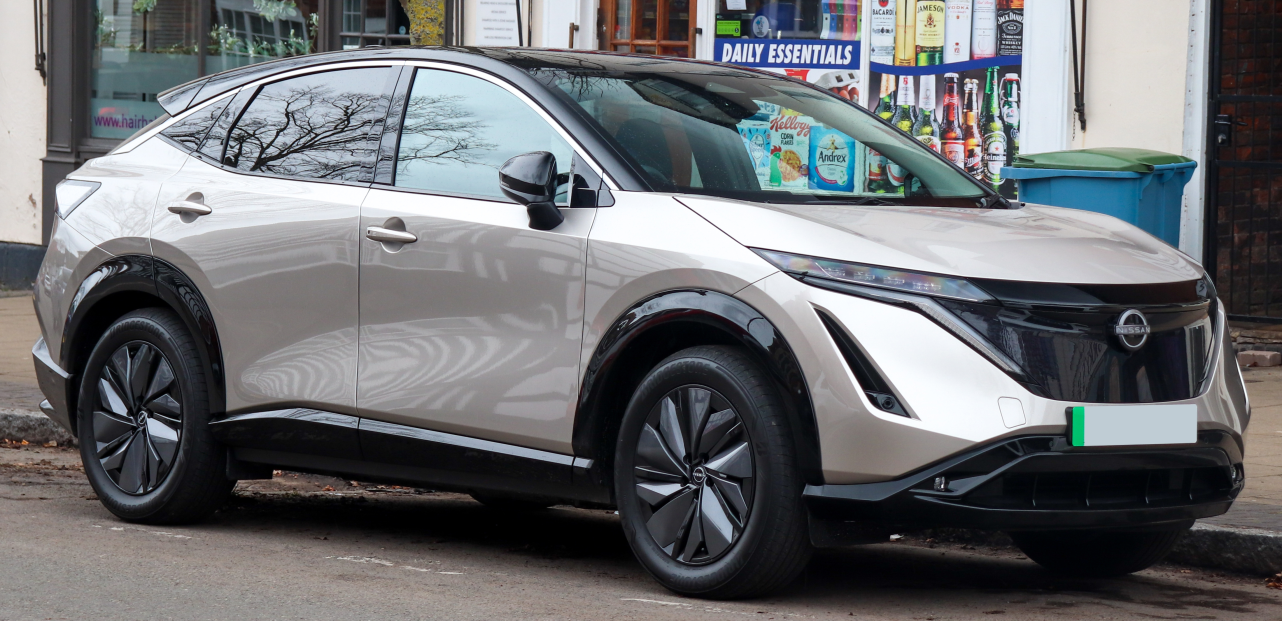
Nissan Ariya Dimensions, Ground Clearance and Charging
Updated November 3, 2026.
The Nissan Ariya is a five-seat electric crossover with different batteries, drivetrains and charging connections across markets. Common European versions offer 63 or 87 kWh of usable battery capacity. If you are considering an imported car in Ukraine, its original market matters as much as its advertised range. A European, American, Chinese or Japanese Ariya may need different charging equipment.
Nissan Ariya dimensions: how long, wide and high is it?
For the regular European Ariya, Nissan lists a length of 4,595 mm, a body width of 1,850 mm and a height of 1,660 mm. Width including the extended mirrors is 2,172 mm. Use the mirror-inclusive figure when assessing a narrow garage entrance or a space between parking columns. These measurements should not automatically be applied to NISMO or every version sold in another market.
| Dimension | Value |
|---|---|
| Length | 4,595 mm |
| Width, no mirrors | 1,850 mm |
| Width, with mirrors | 2,172 mm |
| Height | 1,660 mm |
| Wheelbase | 2,775 mm |
| Clearance, UK 2026 | 185 mm |
| Clearance, AU MY25 | 182 / 180 mm |
UK 2026 refers to the updated British specification; AU MY25 refers to Australian model year 2025. In the Australian specification, 182 mm applies to the 63 kWh battery and 180 mm to the 87 kWh version.

Official Nissan illustration: A indicates length, B width and C height. The pictured specification may differ from the car you are considering.
Nissan Ariya ground clearance is not one universal figure for every model year and market. The difference between the official regional specifications above is a reason to check the exact vehicle. Load, tyres and suspension condition also affect the space beneath the car. Battery protection does not make contact with kerbs or raised obstacles harmless.
Checking whether an Ariya fits your garage involves more than comparing its body width with the doorway. Allow room to open the doors, walk beside the car, reach the charging port and raise the tailgate. If a charging unit will be mounted on a wall, decide where the vehicle will park and whether the cable can reach without stretching or obstructing a walkway. Measure the usable space yourself rather than relying on the parking bay's nominal dimensions.
Nissan Ariya battery capacity: 63 and 87 kWh
Usable capacity describes the energy made available within the battery management system's operating limits. It should not be confused with the pack's total nominal capacity. An advertisement using a figure around 90 kWh does not prove that the same amount is available for driving. Confirm the factory specification through the VIN and request a battery assessment when buying a used vehicle.
The Ariya uses liquid thermal management for its traction battery. Cooling and heating do not guarantee identical charging performance in every season. Battery preparation features, their controls and the relevant software vary by version. Read the correct manual rather than assuming that every Ariya automatically arrives at a rapid charger with the battery at its preferred temperature.
A useful inspection considers repair history, the underside of the battery enclosure, diagnostic messages and charging behaviour. Try both AC and DC charging where practical. The remaining-distance estimate on the dashboard reflects recent consumption; it is not a direct measurement of usable capacity. A single displayed state-of-health percentage also needs context, including the method used to obtain it.
Range: laboratory ratings and your actual journey
Compare range only after identifying the battery, drivetrain, wheels and test cycle. WLTP, EPA and Chinese laboratory ratings are not interchangeable. One European Nissan page, for example, lists up to 404 km WLTP for a 63 kWh version and up to 536 km for a particular front-wheel-drive 87 kWh version. Those are specified configurations, not promises for every imported Ariya or every journey in Ukraine.
For a practical estimate, divide available energy by consumption and multiply by 100. An illustrative 60 kWh at 20 kWh/100 km corresponds to 300 km without a reserve. At 25 kWh/100 km, the same energy corresponds to 240 km. This is a calculation example, not a TOKA road test or a measured winter result for the Ariya.
You will normally use only part of the battery between stops. Seventy percent of an illustrative 87 kWh is 60.9 kWh before allowing for the actual battery condition. Leave energy for a diversion, headwind or alternative charging location. A larger battery offers more flexibility, but it does not remove the need to find compatible and accessible chargers. Update the plan using the car's actual consumption once your journey has started.
Charging ports: Europe, North America, China and Japan
European versions use Type 2 for AC charging and CCS2 for DC. Check American imports for J1772/Type 1 and CCS1, and Chinese-market cars for GB/T AC and GB/T DC. Nissan's Japanese Ariya manual describes CHAdeMO rapid charging. The actual port, model year and any documented conversion take priority over a generic model listing.
Ask for clear photographs with the charging flaps open before ordering equipment. If the car has been converted, request details of the installed components and supported charging modes. An AC adapter does not automatically provide DC compatibility. Similar-looking plugs also do not establish protocol support. For a European specification, explore Type 2 charging equipment for an appropriate AC setup after confirming the onboard charger's phases and current limit.
A Chinese-market car needs a separate assessment. The GB/T DC charging station selection can help identify equipment for a verified use case, but the connector name alone is not a complete compatibility check. Confirm the vehicle, station, operating parameters and any adapter requirements before purchase. Do not assume that an accessory described as universal will work with every Ariya or public charger.
Home charging: check the onboard AC charger
Not every Nissan Ariya accepts 22 kW AC. Different years and markets have different onboard chargers. The Nissan UK press kit issued in July 2026, for example, specifies 11 kW for the updated range it describes. Earlier regional specifications include other arrangements, such as 7.4 or 22 kW depending on the version. A charging station's nameplate rating does not change the car's limit.
The available AC power is limited by the car, supply, charging unit and cable. A single-phase connection does not become three-phase when a more powerful charging station is installed. Before installation, establish the site's available capacity, other household loads, earthing and required protective devices. The electrical design needs to match the equipment documentation and the actual property, including where the car will be parked.
A reference to a 220 V socket without a current rating is not enough to calculate time. At 16 A, power is about 3.52 kW. Adding an illustrative 87 kWh would therefore require roughly 24.7 hours even before losses. A blanket promise of a full charge in 14 hours from any domestic socket is incorrect. For daily use, calculate the energy you need to replace: an illustrative 20 kWh at an average 7 kW takes about 2.9 hours before charging losses.
DC rapid charging and route planning
Verified Nissan specifications include versions of both the 63 and 87 kWh batteries with a 130 kW maximum DC charging capability. A general 100 kW limit for every smaller-battery Ariya is therefore misleading. The peak rating is not the average power throughout a session, and it does not mean that the car will maintain that rate to 100%.
Nissan's European charging explanations associate charging times with a stated battery interval and conditions. A 20–80% figure should not be relabelled as 10–80% or a full charge. Battery temperature, starting charge, the station's condition and shared power can all affect the stop. Your previous sessions in comparable weather are useful planning evidence, provided the battery and charger conditions are also similar.
Before travelling, use the TOKA map to check suitable charging connections. Confirm the port standard, current price, access arrangements and connector status. Keep an alternative within your remaining energy budget. A location on the map does not reserve an available connector for your arrival. If the required standard is uncommon along the route, plan that alternative before the battery gets low.
Interior, boot space and trim differences
The Ariya accommodates five people, with an open layout around the front seats. Relevant European specifications list 466 litres of boot space for front-wheel drive, while an e-4ORCE version may have 408 litres. Market, equipment and measurement method matter. Try your own pushchair, cases or other regular luggage, including the opening and floor height, rather than choosing solely by the largest quoted volume.
Digital displays, a sliding console, panoramic roof, head-up display, seat heating and ventilation are not an identical equipment package on every Ariya. Basic, Top, Advance and Evolve are names used in particular markets and years. Check the actual build specification and demonstrate the functions in the vehicle. A translated trim name in an advertisement is not proof of every feature that appears in a review.
Test your own phone before buying. Nissan's Australian MY25 specification, for example, distinguishes wireless Apple CarPlay from wired Android Auto. Wireless support for both should not be promised for every car. Ukrainian menus, voice control, online navigation and remote app access also need checking after import. Establish whether the previous owner's account can be transferred and whether the services you need operate in the country where you will use the vehicle.
Motors, e-4ORCE and regenerative braking
A front-wheel-drive Ariya uses one motor; e-4ORCE versions use two with control of drive between the axles. Output and acceleration depend on the version. Do not combine NISMO figures, a regular e-4ORCE specification and a front-wheel-drive model into a single description of the top Ariya. Compare kW and 0–100 km/h times from a document covering the same year and market, and distinguish those results from American 0–60 mph measurements.
Regenerative braking recovers some energy during deceleration. The e-Pedal Step system does not replace use of the brake pedal to bring the vehicle to a complete stop. That distinction matters if you are familiar with the Leaf's one-pedal behaviour. Learn the available modes in a safe setting, maintain a suitable following distance and account for changes in regenerative braking with battery conditions. Comfortable deceleration is not a substitute for checking the conventional braking system.
Safety, winter use and servicing in Ukraine
ProPILOT, surround-view cameras and automatic parking depend on the specification. Driver assistance does not make the vehicle autonomous or guarantee detection of every hazard. Following accident repairs, inspect the restoration and calibration of the components actually fitted. The absence of a dashboard warning alone does not demonstrate that every assistance function works correctly.
In winter, watch consumption at your own speed, cabin-heating demand and the predicted energy at the next charger. There is no fixed 20–30% range reduction that applies to every temperature and route. Check heat-pump equipment and battery preparation features for the exact version. Do not assume that every imported Ariya received a special Ukrainian suspension setup or extra corrosion treatment without documentation of the work.
Maintenance still includes tyres, brakes, suspension, filters and cooling systems according to the correct schedule. If recovery is required, follow the instructions for that drivetrain and agree the transport method with the operator. Avoid experimenting with towing an inoperative car based on a general review. A warranty offered in the original country does not automatically cover a parallel import in Ukraine; establish VIN-specific terms and who will actually carry out repairs.
Ownership costs, alternatives and model updates
Compare the complete purchase and ownership budget: vehicle condition, delivery, registration, possible repairs, charging equipment, insurance and servicing. Calculate energy expenditure from the required kWh, charging losses and the current tariff. A fixed price for a full charge without the battery size, starting percentage and electricity price is not a reliable budget. Your split between home charging and public DC sessions also matters.
Alternatives include the Volkswagen ID.4, Hyundai IONIQ 5, Kia EV6 and Tesla Model Y; the BMW iX belongs to a different size and price scenario. Compare particular years, batteries, charging ports, interior arrangements and service options. Broad claims about national build quality do not replace an inspection or test drive. For a family car, seating comfort and the convenience of charging on regular routes may be more useful than the highest advertised acceleration figure.
The 2026 update does not make an earlier car identical to a new one. Changes to infotainment, battery preparation and power supply to external devices belong to a defined specification. V2L for appliances and V2H for a building are different applications. Supplying a home requires confirmed vehicle support, compatible equipment and an appropriate electrical design; an ordinary charging cable does not turn every Ariya into a home backup system.
Frequently asked questions
How high is a Nissan Ariya?
The regular European specification lists a height of 1,660 mm. Check the actual version and allow separate space for accessories or an open tailgate when assessing a garage.
How wide and how long is an Ariya?
The cited European version is 4,595 mm long and 1,850 mm wide without mirrors, or 2,172 mm with mirrors extended. The mirror-inclusive width is the more relevant figure for a narrow entrance.
What is the Nissan Ariya ground clearance?
The updated UK specification gives 185 mm; Australia's MY25 specification lists 180–182 mm depending on the battery version. Confirm the market, version and measurement conditions.
Does every Ariya have CCS2 and 22 kW AC charging?
No. The port and onboard AC capability vary by year and market. The Japanese manual describes CHAdeMO rapid charging, while other regions use their respective standards.
What range, warranty and language support should I expect from an import?
Estimate range from the actual battery and consumption, check warranty coverage by VIN, and test the infotainment and connected services. The Ariya name alone does not guarantee a winter distance, local warranty or a particular interface language.
You may also like...
-
Innovations in charging technologies Electric Crossovers: Models, Family Practicality and Charging in Ukraine

-
Innovations in charging technologies Volkswagen ID. UNYX: Specs, Trims, Range and Charging
-
Innovations in charging technologies Electric Car Customs Clearance in Ukraine 2026: VAT, Duty and Excise