Installation of Electric Vehicle Charging Stations
Updated September 15, 2026.
Electric vehicle charging station installation starts with checking available electrical capacity, choosing a location and agreeing on the connection arrangements. A designer then specifies the circuit and protection, an installer fits the equipment, and testing and a trial charging session take place before normal use. The budget depends on more than the charger: cable distance, the condition of the distribution board and any required capacity increase can substantially change the total.
This guide is for homeowners, apartment residents and businesses planning a charging point in Ukraine. It helps you prepare a brief for a contractor; it is not a wiring guide or a substitute for a site-specific electrical design.
- Start with: the vehicle, daily driving distance, parking time and the existing electrical supply.
- Before purchasing: arrange a survey, identify required approvals and request an itemised quotation.
- Before use: check protection, settings, metering and maintenance arrangements.
Choosing a Charging Station for Your Site
Select equipment for the intended use, not simply the highest power rating in a catalogue. With AC charging, the relevant vehicle limit is its onboard charger, not its traction inverter. A 22 kW charging point cannot deliver that charging rate to a car limited to 7.4 kW AC.
- Home wallbox: a fixed AC charging point for longer parking periods. Common 7.4, 11 and 22 kW options require a suitable supply and a compatible vehicle.
- Portable EVSE: charging equipment with control and protection for connections permitted by its manufacturer. It does not remove the need to inspect the socket and wiring; a universal 3.5 kW maximum does not apply to every portable model.
- Commercial AC or DC station: the choice depends on parking duration, expected demand, available network capacity and the business model.
- Multiple charging points: a shared car park also needs suitable user accounting, access management and allocation of available power.
When comparing charging equipment for a private parking space, check the connector, supply phases, cable length, enclosure suitability and authorisation method. Matching the equipment to the vehicle helps avoid paying for a charging rate the car cannot use.
Installing an EV Charger at a Private House
Home charging is convenient when the car regularly remains parked for several hours. However, a three-phase meter alone does not establish that enough spare capacity is available. The assessment should cover the site's agreed power limit, actual loads, distribution board, cable circuit and permitted current.
For example, if a house has an assumed 15 kW limit and other appliances draw 6 kW simultaneously, the arithmetic remainder is 9 kW. An 11 kW charger without load management would not fit that scenario. This is an illustrative calculation, not a design: an electrician must also assess how loads are distributed across the phases.
The design must provide an appropriate protective earth, overcurrent protection and residual-current protection suitable for the specific EVSE. Requirements for the RCD type and DC leakage detection depend on the equipment and electrical arrangement. Do not choose breaker ratings or cable sizes solely from internet advice. Read more about checking earthing before a home installation.
Principles for assessing the supply, distribution board and protective devices are explained in Schneider Electric's engineering guide. A qualified professional should determine the actual installation requirements after surveying the site.
EV Charging Installation in Courtyards and Shared Car Parks
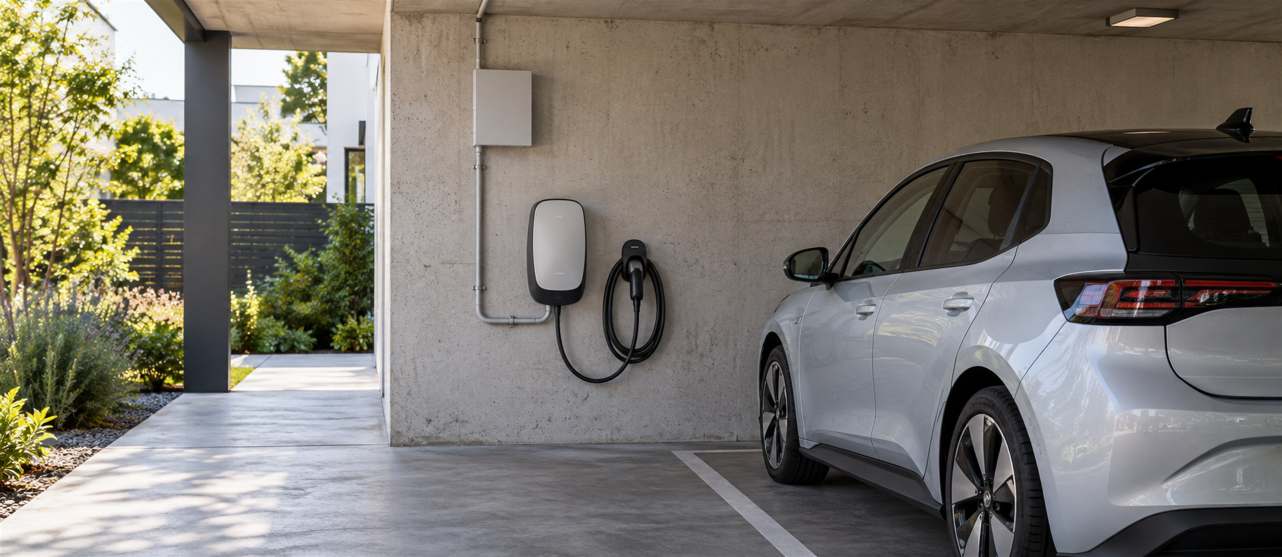
For an outdoor location, assess access, vehicle impact risk, rain, condensation, temperature and the cable route. A charging point may be wall-mounted or fitted to a support approved by its manufacturer. Installation conditions must follow the equipment instructions: a canopy or flexible conduit alone does not guarantee adequate protection.
The charging cable must not obstruct an escape route or pedestrian access. Mounting height, clearances, mechanical protection and penetrations through building structures belong in the design. An underground car park also requires consideration of the premises and the building's applicable operating rules.
In a shared car park, establish the rights to use the space, cable route and electrical network first. Use of a parking space does not automatically permit connection to a communal distribution board. Agree on the proposed arrangement, metering, payment, board access and maintenance responsibilities with the building manager or homeowners' association. TOKA provides information on connecting charging points in residential developments.
For several charging points, distinguish power balancing between ports from dynamic management of the whole site's load. Port balancing does not necessarily account for cooking equipment, heating or lifts. When reviewing chargers with power balancing between ports, confirm how the function works, whether sensors are needed and which control systems are compatible.
Commercial Charger Installation for Businesses and Shopping Centres
Start a commercial project by evaluating visitor numbers, parking duration, existing electrical capacity and expected charging sessions. Longer AC charging may fit hotel or office users. A transit location may benefit from DC equipment for short charging stops, but the connection requirements and financial assumptions need assessment before choosing it.
Plan lighting, wayfinding, access to parking spaces, connectivity and user support. For paid charging, agree on billing, authorisation, tariff conditions and session records. CRM integration is not mandatory for every location: select the functions that actually support the operating model.
An OCPP specification does not guarantee that any platform integration will work without configuration. Check the protocol version, platform compatibility and supported functions. Estimate payback using realistic utilisation and operating costs, not the charger's power rating alone.
Permits and Approvals for EV Charger Installation in Ukraine
There is no single universal “charger permit” covering every address. Check the right to use the location and electrical infrastructure, any required design or construction approvals, and the metering and electricity supply arrangements separately. The documents needed depend on the site and connection method.
- Private house: establish whether the additional load fits the existing connection conditions. If more capacity is required, agree on the process with the distribution system operator before installation rather than simply notifying it after exceeding the agreed limit.
- Residential development or car park: identify the network owner, confirm the proposed cable route is permitted, obtain the necessary decisions concerning shared property and agree on payment arrangements.
- Business: alongside the technical connection, check the right to use the land or premises, contracts, metering and arrangements for providing a paid service.
Providing an EV charging service does not, by itself, require an electricity supply licence. This distinction is explained in the Ukrainian energy regulator's official clarification. Other requirements for electrical connections, business activity and property use still apply. Before a commercial launch, have a suitably qualified specialist confirm the steps for your particular project.
EV Charging Station Installation Cost: What the Quote Should Include
The cost of installing a charging point is not just the price of a wallbox. Ask the contractor to separate the quotation into understandable items:
- The charging station, cable, mounting hardware or support and any required additional modules.
- The site survey, design work and approvals where needed.
- The cable route, including its length, materials and installation method.
- The distribution board, protective devices, earthing, metering and load management.
- Installation labour and any excavation or reinstatement work.
- Testing, configuration, a trial session and handover documentation.
- Separately, any supply capacity increase, connectivity, platform charges and ongoing servicing.
As an equipment-price example, on September 15, 2026 the listing for the 22 kW TOKA SW122-C22 with a Type 2 cable displayed UAH 51,790. This is the price of a specific unit, not an installation charge or the minimum price of all charging stations. Confirm the current price and included equipment before ordering.
Two identical chargers can have different installation budgets. A short connection beside a suitable board and a long route across a car park involve different work. A universal turnkey price should not be promised without a survey. Also confirm taxes, deadlines, warranty terms and any excluded work.
Installation Stages and Handover Checks
- Survey: assess the vehicle, supply capacity, loads, distribution board, distances and mounting location.
- Design and quotation: agree on the circuit, protection, metering, materials, work and responsible parties.
- Preparation and installation: appropriately qualified specialists follow the design and the equipment manufacturer's instructions.
- Verification: perform the required measurements, test protective functions and configure the permitted charging power.
- Handover: complete a trial session, explain operation to the owner and provide documents and service contacts.
Ask how to stop charging, respond to an error and resume operation after a power interruption. Check that session accounting works correctly and that an unauthorised person cannot start charging if access is intended to be restricted. A successful session alone is not a substitute for the required inspection and test results.
Common Installation Mistakes and Ongoing Maintenance
Common mistakes include choosing a power rating without checking the supply, connecting without an appropriate protective earth and protection, using damaged or unsuitable components, overlooking weather exposure and routing cables without the necessary agreement. Request equipment documentation and evidence of conformity with applicable requirements rather than relying on the word “certified” in advertising.
Inspection frequency should follow the manufacturer's instructions and operating conditions. Cable damage, overheating, an unusual smell, repeated protective trips or a fault message are reasons to stop using the equipment and contact service support. Do not bypass protection to start a charging session.
To discuss an installation with the TOKA team, prepare the car's model and year, the address, photographs of the distribution board without personal information, the agreed supply capacity, the approximate cable distance and the number of charging points. This short brief helps the team prepare a site-specific proposal.
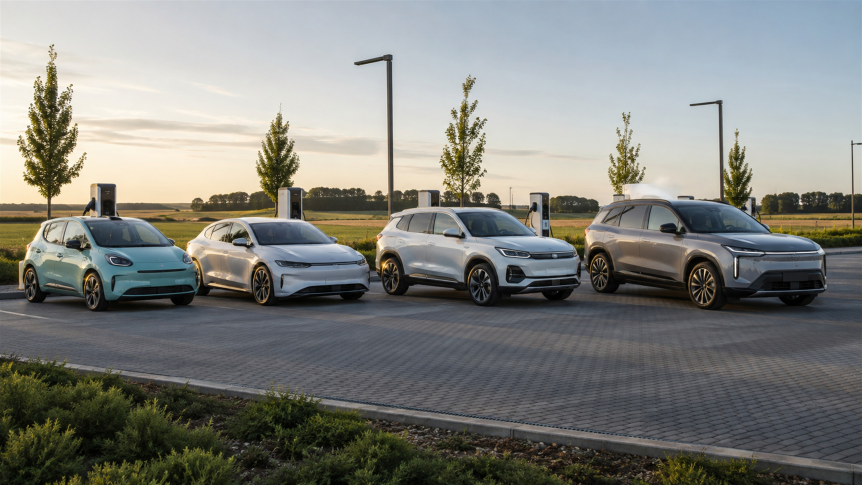
The cover is an AI-generated illustration of a generic charging space, not a photograph of a completed project or a wiring diagram.
Frequently Asked Questions
Can I install a charging station myself?
Entrust a fixed electrical connection to a qualified professional. Installation requires calculations, suitable protection and testing. This article does not replace a design or the manufacturer's instructions.
Does home charging always require more supply capacity?
No. First assess the available reserve, permissible operating settings and load-management options. If capacity is insufficient, ask the network operator about the process for changing the connection conditions.
Does a car park charger need a separate electricity meter?
Metering depends on the connection arrangement and contracts. Distinguish billing-grade electricity metering from internal charging-session records, and agree in advance who pays for which consumption and services.
How long does charging station installation take?
Physical installation and the complete project have different timelines. The schedule depends on surveys, approvals, delivery, cable routing and any new or upgraded connection. Request a separate timeline for each stage.