Do You Need Grounding to Charge an Electric Vehicle: What You Should Know?
Updated September 15, 2026.
Home EV charging on a conventional supply needs a sound protective earth connection and correctly selected electrical protection. If a socket's protective contact has not been verified, or the charger reports an earthing fault, do not start charging until an electrician has checked the installation. Reducing the current, adding an adapter or enabling Wi-Fi does not fix a missing protective conductor.
This guide helps vehicle owners prepare for home AC charging and discuss the installation with a qualified electrician. It is not a DIY wiring guide or an electrical design. The correct solution depends on the building's supply system, the charging equipment and local requirements. Earthing is also called grounding.
Why an EV charger needs protective earthing
The protective conductor, PE, connects the equipment's designated conductive parts to the installation's protective system. If insulation fails, that connection helps the protection disconnect the supply automatically. The neutral conductor, N, has a different function: it must not be improvised as a substitute for PE at the socket.
- PE and the earthing system: provide the protective connection and contribute to protection against electric shock.
- Circuit breaker: protects the circuit against overcurrent; its rating must suit the cable and installation conditions.
- Residual current device, RCD: disconnects at specified residual-current conditions; its type and characteristics must suit EV charging.
- Charger ground monitoring: detects certain connection faults. It does not create a protective conductor.
Earthing is not a voltage stabiliser and does not guarantee protection against every overvoltage event. An overheating socket, an overloaded circuit and damaged insulation are different faults. A charging installation therefore cannot be assessed by looking for just one safety feature.
Earth bonding for an EV charger: is it the same as an earth rod?
No. Protective bonding connects specified conductive parts to limit dangerous differences in potential; an earth rod is an electrode in contact with the soil. Both belong to the wider installation design, but one term does not replace the other. The Schneider Electric guide to earthing connections explains the distinction. Ask the installer to assess the required bonding and earthing together, rather than simply adding a rod.
Can you charge an electric car without grounding?
For a conventional home charger, the practical answer is not to use an unverified connection without PE. A charging session starting successfully is not proof of electrical safety. A problem may become apparent only after insulation deteriorates or a connection becomes loose.
Possible consequences include hazardous voltage on accessible conductive parts, electric shock, interrupted charging and equipment damage. Moisture and damaged connectors deserve particular attention. However, not every vehicle fault can be attributed to earthing without diagnosis, and warranty consequences depend on the manufacturer's actual terms rather than an automatic rule.
- Do not fit a neutral-to-earth jumper in a socket.
- Do not improvise an earth connection using plumbing, heating pipes or an unrelated metal structure.
- Do not use ground-emulation adapters or disable ground monitoring to bypass a fault.
- Do not treat low charging current, dry weather or an RCD as a substitute for the required protective connection.
Special supply arrangements and engineered solutions exist, but an electrician must assess them against the equipment documentation. They are not blanket permission to charge from an old two-wire socket.
How should earthing for EV charging be installed?
Start with an assessment of the electrical installation, not a shopping list of earth rods. The electrician needs to establish the supply arrangement, the condition of protective conductors, the suitability of a dedicated circuit and the charger's installation requirements. A suitable existing building earthing system may mean that a new independent electrode is unnecessary.
Installation or improvement work may require specified electrodes, protective conductors, connectors and corrosion protection for joints. Their selection depends on material compatibility, soil conditions, mechanical strength and service life. A copper-bonded or galvanised rod alone is not proof that the complete system is adequate.
The number, length and spacing of electrodes and the conductor cross-sections cannot be prescribed by a universal “three rods for every garage” recipe. Cross-sectional area is measured in mm²; it is not the wire's diameter. The finished arrangement must be verified by appropriate measurements, not simply by looking at the installation.
Before commissioning work, provide the vehicle model, charger manual, available electrical capacity and parking location. Our guide to planning a home charging installation explains the broader preparation process.
What earth resistance does an EV charger require?
Neither “30 ohms” nor “10 ohms for a quality charger” is a universal acceptance criterion. Electrode resistance, PE continuity and fault-loop parameters are different measurements. Their assessment depends on the supply system, protective devices and manufacturer's requirements.
The Schneider Electric guide to TT systems, for example, relates acceptable resistance to RCD characteristics. A resistance reading without that context is not a safety assessment. Ask for the measured results and the applicable acceptance criteria in the inspection record.
Type B RCDs and DC leakage protection
EV charging protection must account for possible DC residual current. Schneider Electric's charging-circuit guidance discusses Type B RCDs or a coordinated Type A/F arrangement with 6 mA DC residual-current detection. The charger's instructions determine the appropriate arrangement.
Check which protective functions are built in and which must be installed externally. A product listing that says “leakage protection” does not specify the entire system. Request documentation identifying the device type, ratings and coordination requirements. An RCD does not remove the need for the required PE connection.
Tesla grounding errors: what the owner should do
A protective-conductor problem and residual-current detection are not the same fault. Record the exact message, charger model and indicator pattern. Do not assume that fault codes are interchangeable between Mobile Connector, Wall Connector and different hardware generations.
Tesla's Gen 3 Wall Connector Ground Assurance documentation describes monitoring and charging lockout when high impedance is detected. Its scope is that equipment version; settings depend on the supply arrangement and region. Have an electrician investigate rather than bypassing the lockout.
A checklist for installation, maintenance and charger selection
- Before installation: agree the electrical load, cable route, earthing arrangement, protective devices and installation environment.
- After installation: obtain the required inspection and test results, including PE, insulation, protective-device operation and other checks applicable to the design.
- Before use: inspect accessible cables and connectors. Stop using equipment with damage, a burning smell, abnormal heating or repeated fault warnings.
- During maintenance: follow manufacturer intervals and the electrician's recommendations. An RCD TEST button does not replace inspection of the complete installation.
Do not test protective contacts by touch or with homemade instruments. Avoid improvised extension leads and adapters; permitted connection methods are defined by the charging equipment manufacturer.
If your car has the corresponding AC inlet, compare charging equipment with Type 2 connectors. For a specific unit such as the TOKA SW107-S charging station, request the current installation documentation. Connector compatibility does not establish that the electrical supply is suitable, and higher charging power does not imply better protection.
Until the home connection has been checked, find a compatible location on the map of available charging locations. Confirm the connector, access arrangements and current station status before travelling.
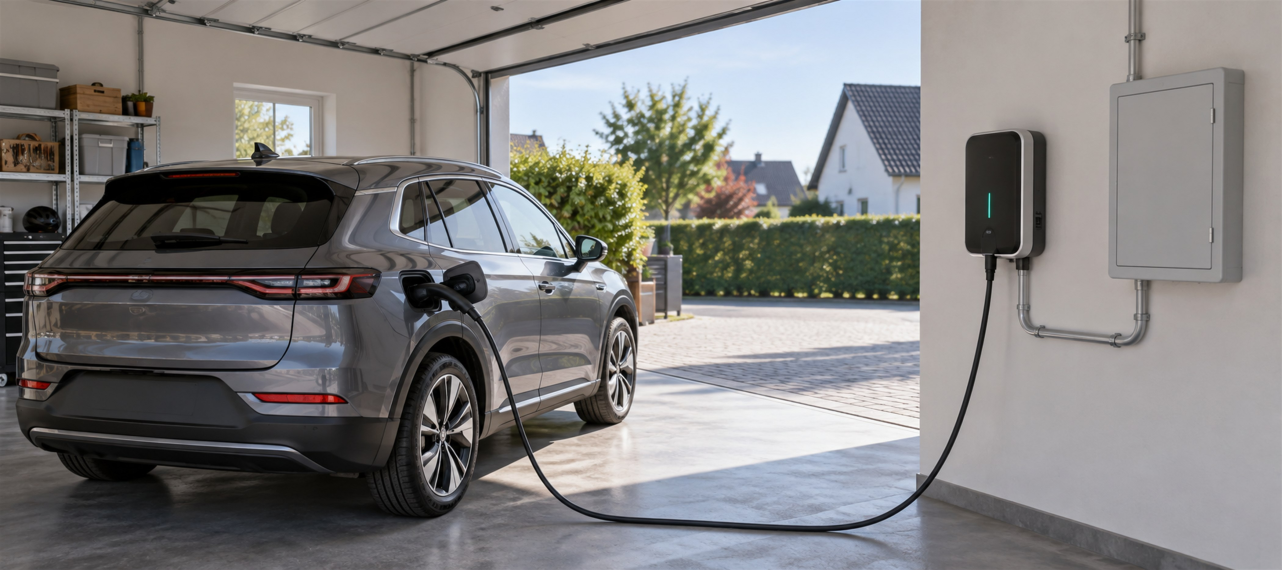
The cover is an AI-generated illustration of home EV charging, not a photograph documenting a TOKA installation.
Frequently Asked Questions
Does charging from an ordinary socket require earthing?
Yes, a conventional home connection needs a working PE and a suitable circuit. Visible protective contacts do not prove that a socket is correctly wired or that the whole circuit is suitable for sustained charging.
Will reducing the charging current help if there is no earth?
No. It changes the electrical load but does not restore a missing protective conductor or make that connection safe.
Does every EV charger need a separate earth rod?
Not necessarily. The decision depends on the building's supply arrangement, existing earthing and installation design. Do not independently separate or combine protective systems.
Does the absence of a fault message prove the grounding is sound?
No. Charger self-diagnostics do not replace electrical testing and inspection of the entire circuit. A successful charging start is not a substitute for that assessment.
You may also like...
-
Innovations in charging technologies Ford Focus Electric: a complete overview of characteristics, advantages and disadvantages for the Ukrainian market

-
Innovations in charging technologies TOP 16 myths about electric vehicles

-
Innovations in charging technologies Hyundai IONIQ 5 in Ukraine: specs, price, range and charging