Design of an electric car: how does the motor work and the main components?
Electric vehicles are becoming an integral part of modern transportation, offering an environmentally friendly and efficient alternative to traditional internal combustion engine (ICE) vehicles. Understanding the design of an electric vehicle, how its components work, and how they differ from internal combustion engine vehicles is important for evaluating their advantages and disadvantages.
Main Components of an Electric Vehicle
An electric vehicle consists of several key components that make it work:
Traction Battery
The traction battery is the primary energy source for an electric vehicle, supplying power to the electric motor and other systems. Its capacity determines the vehicle's range, while its construction technology affects weight, cost, and lifespan. Modern electric vehicles are typically equipped with lithium-ion batteries, which have a high energy density and long service life.
Types of Batteries
- Lithium-ion (Li-ion) – The most common type in modern electric vehicles, offering high capacity and energy density.
- Lithium iron phosphate (LiFePO₄, LFP) – More durable and safer but with lower energy density.
- Nickel-metal hydride (NiMH) – Previously used in early hybrid vehicles but less efficient compared to lithium batteries.
- Solid-state batteries – A promising technology that provides even higher energy density but is still in development.
Battery Capacity and Voltage
Battery capacity is measured in kilowatt-hours (kWh) and defines how much energy the battery can store. For example, the Nissan Leaf’s 40 kWh battery allows a range of up to 270 km on a single charge. Battery voltage ranges from 300V to 800V depending on the vehicle model, affecting its power and efficiency.
Placement and Structural Features
Most modern electric vehicles have battery modules located in the floor of the vehicle. This ensures a low center of gravity, improving handling and safety. Batteries typically consist of multiple modules, each containing individual cells integrated into a Battery Management System (BMS), which regulates charging and discharging to prevent overheating and extend battery life.
Power Electronics
Power electronics manage energy flow between the battery and the electric motor, ensuring optimal system performance. This includes an inverter that converts direct current (DC) from the battery into alternating current (AC) for the electric motor and a controller that regulates speed and direction.
Types of Electric Motors
- Permanent Magnet Synchronous Motors (PMSM) – These motors are highly efficient, compact, and have a high power density. They provide superior acceleration and dynamics but require rare-earth magnets, which increase their cost.
- Induction Motors (IM) – Widely used due to their reliability and durability. They do not require permanent magnets and are less expensive to manufacture, but they are less efficient compared to synchronous motors.
Operating Principle and Features of Each Type
Permanent magnet synchronous motors create a rotating magnetic field using the stator, while the rotor, containing permanent magnets, moves synchronously with this field. This ensures high efficiency and precise speed control.
Induction motors work on the basis of electromagnetic induction: alternating current in the stator creates a rotating magnetic field, which induces currents in the rotor, causing it to move. They are less efficient, but are simple to manufacture and highly reliable. An electric motor converts electrical energy from the battery into mechanical work, driving the wheels of a car. It consists of a stator and rotor, the interaction of which creates torque. Various types of electric motors are used in electric vehicles, including synchronous and asynchronous, each with its own features and advantages.
Power Electronics
Power electronics manage energy flow between the battery and the electric motor, ensuring optimal system performance. This includes an inverter that converts direct current (DC) from the battery into alternating current (AC) for the electric motor and a controller that regulates speed and direction.
Regenerative Braking System
The regenerative braking system allows some of the energy expended during movement to be returned to the battery. When braking or decelerating, the electric motor functions as a generator, converting kinetic energy into electricity and recharging the battery. This improves the overall efficiency of the electric vehicle and extends its driving range.
Charging System (Onboard and External)
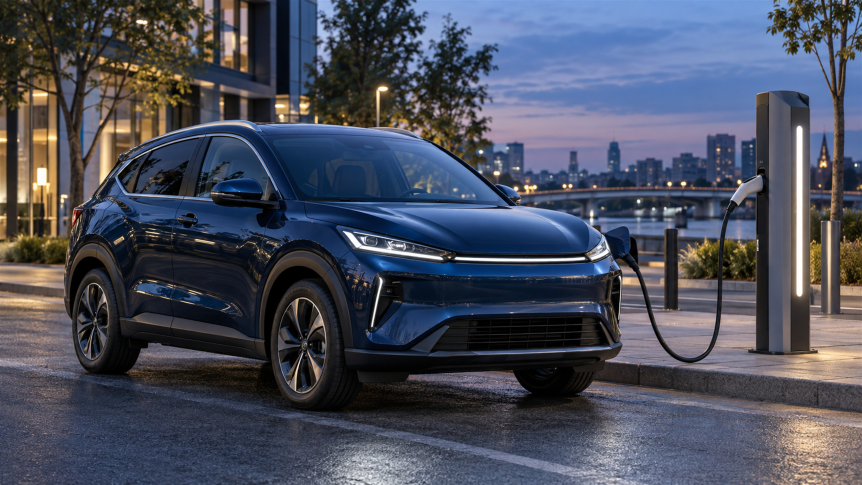
The charging system replenishes the energy stored in the battery. The onboard charger converts AC power from household outlets into DC for battery charging. External charging stations, especially fast chargers, can supply DC power directly, significantly reducing charging time. A well-developed charging infrastructure is a key factor for the widespread adoption of electric vehicles.
Principle of Operation of an Electric Motor in an Electric Vehicle
The electric motor in an electric vehicle operates by converting electrical energy from the traction battery into mechanical movement. This process is based on the interaction of magnetic fields and electric currents, allowing the vehicle to move with high efficiency and minimal energy loss. Unlike internal combustion engines, an electric motor does not require fuel combustion, does not produce harmful emissions, and has significantly fewer moving parts, making it more durable and requiring less maintenance.
Electric motors provide instant torque, allowing electric vehicles to accelerate quickly without delays associated with gear shifting. Thanks to their high energy efficiency, such motors can achieve an efficiency rating of over 90%, which significantly exceeds traditional internal combustion engines, where this indicator rarely exceeds 40%.
Main Components of an Electric Motor
An electric motor consists of two main parts:
- Stator: The stationary part of the motor that creates a rotating magnetic field.
- Rotor: The moving part, located inside the stator, which rotates under the influence of the magnetic field.
The interaction between the stator and rotor’s magnetic fields creates torque, which drives the vehicle’s wheels.
Conversion of Electrical Energy into Mechanical Energy
The principle of operation of an electric motor is based on the law of electromagnetic induction. When an electric current is supplied to the stator windings, it generates a rotating magnetic field that induces currents in the rotor. The interaction of these currents with the stator’s magnetic field causes the rotor to rotate, converting electrical energy into mechanical motion.
Differences Between Synchronous and Asynchronous Electric Motors
Two main types of electric motors are used in electric vehicles: synchronous and asynchronous.
- Synchronous Electric Motors: The rotor rotates at the same speed as the stator’s magnetic field. These motors offer high efficiency and precise control but require a complex excitation system.
- Asynchronous Electric Motors: The rotor rotates at a slightly different speed than the stator’s magnetic field (slip). These motors are simpler in design and more reliable but have slightly lower efficiency than synchronous motors.
Comparison of Electric Vehicles and Internal Combustion Engine (ICE) Vehicles
Electric vehicles (EVs) and internal combustion engine (ICE) vehicles have fundamental differences not only in the type of fuel they use but also in efficiency, environmental impact, operating costs, and maintenance requirements. Modern electric vehicles offer several advantages, but they also have limitations that may influence a buyer’s decision.
Environmental Aspects
Electric vehicles do not produce exhaust emissions during operation, significantly reducing greenhouse gas emissions and improving air quality in urban areas. However, battery production is associated with the extraction of rare earth metals, which can have a negative impact on the environment. On the other hand, ICE vehicles emit CO₂ and other harmful substances, contributing to air pollution and climate change.
Economic Aspects
Although the initial cost of electric vehicles may be higher than that of ICE vehicles, operating costs are generally lower. Electricity is cheaper than fuel, and maintenance expenses are reduced due to fewer moving parts and no need for oil changes. Additionally, many countries offer tax incentives and subsidies for EV owners, making them more financially attractive.
Technical Aspects
Electric vehicles provide high performance due to the instant torque generated by the electric motor, eliminating the need for gear shifting and ensuring smoother acceleration. They also have fewer mechanical components prone to wear and tear, resulting in greater reliability. However, EV driving range is limited by battery capacity, and charging takes longer compared to refueling a gas tank.
Conclusion
Electric vehicles represent a technologically advanced alternative to traditional internal combustion engine vehicles. Their environmental and economic benefits make them appealing to a broad range of users. However, despite continuous advancements, challenges remain, such as charging time, infrastructure limitations, and battery costs. Future developments in battery technology and charging networks are expected to make electric vehicles even more convenient and accessible.