Chevrolet Bolt EUV 2022–2023: Specs, Charging and Buyer Checks
Updated September 9, 2026.
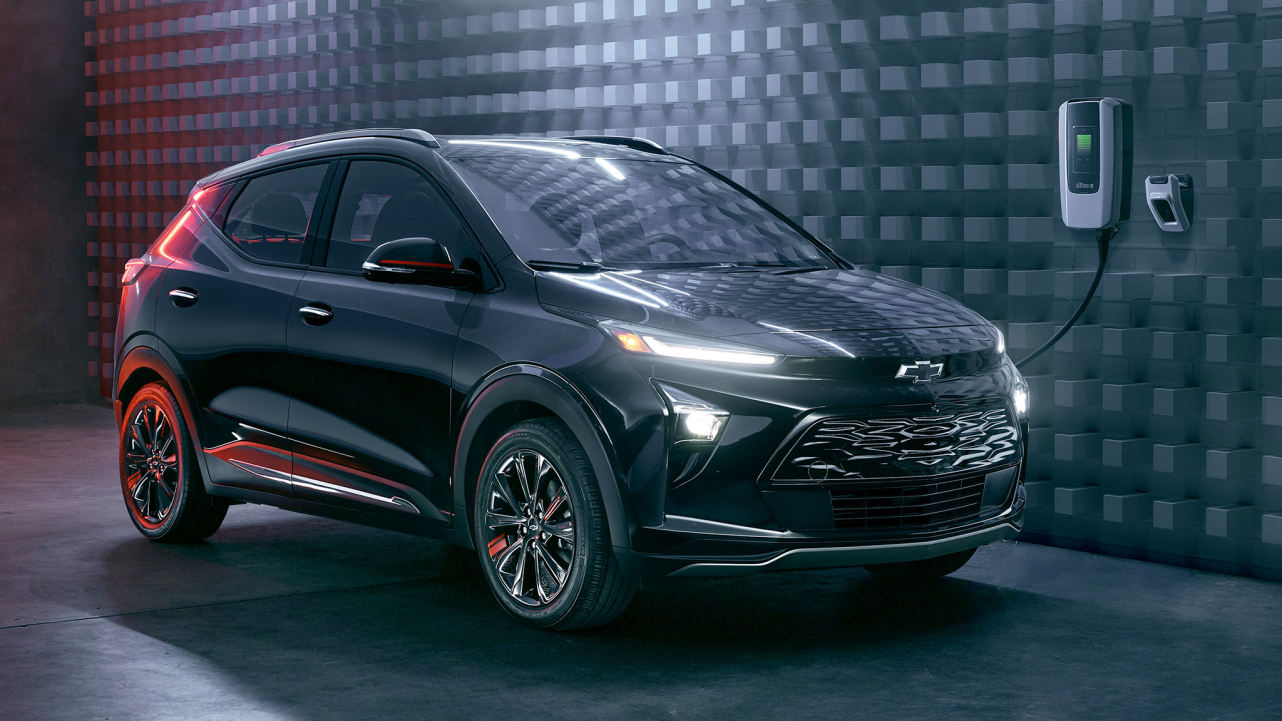
The 2022–2023 Chevrolet Bolt EUV is a front-wheel-drive electric crossover for daily and family use. Chevrolet quoted a 65 kWh battery, a 150 kW (200 hp) motor, 360 Nm of torque and up to 398 km of EPA range for the Bolt EUV. For a US-import vehicle, the important pre-purchase checks are not an advert’s headline number but the VIN, high-voltage battery condition, repair history and connector compatibility in Ukraine.
2023 Chevrolet Bolt EUV specifications
The figures below describe the North American Bolt EUV, which is the basis of most Ukrainian used-car listings. They do not replace a VIN check: LT and Premier equipment and options varied by vehicle.
| Item | Figure |
|---|---|
| Battery | 65 kWh |
| Drive | Front-wheel drive |
| Power / torque | 150 kW (200 hp) / 360 Nm |
| EPA range | up to 247 miles / 398 km |
| Length × width × height | 4,306 × 1,770 × 1,616 mm |
| Wheelbase | 2,675 mm |
| Cargo volume | 462 L; up to 1,611 L with rear seats folded |
Source: Chevrolet’s official specifications. EPA is a standard US test cycle; real range changes with temperature, speed, terrain, tyres and driving style.
Chevrolet Bolt EUV range: how to read the 398 km figure
247 miles (398 km) is an EPA full-charge estimate, not a promise for every route. Winter weather and high-speed driving reduce range; city regeneration can partly offset frequent braking. Plan a reserve to the next charge stop rather than driving to zero on the dashboard estimate.
Before buying a used car, ask for high-voltage-system diagnostics, check that AC and DC charging start and remain stable, and compare actual range with normal consumption on your route. A state-of-charge percentage alone does not establish battery health.
Charging a Bolt EUV in Ukraine: connectors and compatibility
A North American Bolt EUV uses J1772 for AC and CCS1 for DC. Those are different from European Type 2 and CCS2. An imported car should therefore not be assumed compatible with every public charger without checking the exact adapter, its current rating, locking arrangement and a real charging session.
At 240 V / 48 A the car can accept up to 11.5 kW AC; the dual-level charge cord supports up to 32 A at 240 V. Chevrolet also quotes up to 95 miles (about 153 km) in 30 minutes of DC charging. Temperature, starting state of charge and charger output affect the result; see the 2023 Chevrolet Bolt EUV guide.
Before a journey, use the TOKA charging-station map to check the connector at the intended location and use only a safe compatible solution. For home charging, first establish available capacity, grounding, protective devices and connector type; suitable equipment is available in the TOKA catalogue.
Ground clearance, cabin and practicality
“Chevrolet Bolt EUV ground clearance” is a frequent query, but a single aggregator value is not enough for an imported vehicle. The lowest point changes with tyres, suspension condition and measurement method. Inspect the battery protection and underbody on a lift, particularly after collision repair.
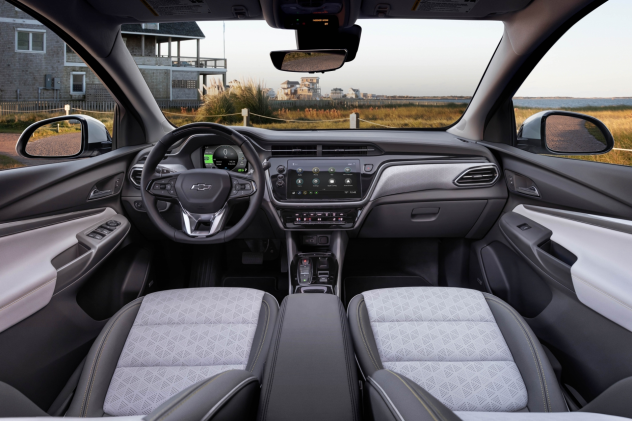
The EUV’s strengths include its 2,675 mm wheelbase and second-row space. Official cargo capacity is 462 L, or up to 1,611 L with the rear seats folded. Heated or ventilated seats, adaptive cruise control and Super Cruise depend on trim and market, so verify the individual vehicle rather than relying on an LT or Premier badge.
What to check before buying a Chevrolet Bolt EUV
- VIN and vehicle history. Confirm equipment, pre-repair photographs, body geometry and country of origin.
- High-voltage battery. Get diagnostics, BMS fault data, an enclosure inspection and AC/DC charging tests.
- Recall campaigns. For vehicles affected by battery campaigns, check status by VIN in NHTSA Recall Lookup, not from a forum list.
- Connectors and adapter. Confirm that the exact adapter suits the charging points you will actually use.
- Road test. Check climate control, regeneration, tyres, charge port and warning lights.
Strengths and limits
| Strength | What to consider |
|---|---|
| Official EPA range up to 398 km | Real range depends on conditions and the specific battery |
| More second-row space than Bolt EV | Assess luggage space and clearance in person |
| AC charging up to 11.5 kW | North American J1772/CCS1 needs compatibility planning |
| 200 hp with front-wheel drive | There is no all-wheel-drive Bolt EUV |
| Common on the used market | Import and repair condition matter more than the year in an advert title |
Verdict
A 2022–2023 Chevrolet Bolt EUV can be a practical electric crossover for city, suburban and family use when the individual car has been checked transparently. For a buyer in Ukraine, the key facts are not a dated price in an article but the VIN, battery, repair history and a workable charging plan. After a road test, plan first stops with the TOKA map and test charging with compatible equipment.
Daily use: city, suburbs and motorway
The Bolt EUV is most convincing in a predictable daily routine: city trips, commuting, school runs or suburban driving with regular access to charging. In that use case, a driver does not need to seek a fast charger every day. Charging at home or work and retaining a reserve for an unplanned trip is usually enough. For a longer journey, the meaningful figure is not a headline range number but a plan with several compatible chargers, a backup location and time for a possible queue.
During the first weeks, record energy use in different weather and at different speeds. This creates a personal, practical range reference rather than an expectation based on one laboratory cycle. Speed and wind affect consumption more noticeably on a motorway than in town; winter adds cabin heat and battery-temperature management. Instead of comparing cars by state-of-charge percentage alone, compare kilowatt-hours per 100 km and the reserve to the next verified stop.
Winter use and climate control
Cold weather is not a reason to avoid an EV, but it changes planning. At low temperatures, some energy is used for cabin heat and the battery may accept charge more slowly. It is more convenient to precondition the cabin while the car remains plugged in, then leave with clear windows and a known reserve. Chevrolet’s manual recommends leaving the vehicle plugged in when temperatures are below 0 °C or above 32 °C if it will sit for a long period, helping the system keep the battery in its operating range.
On a cool-weather test drive, test more than cabin temperature: check windscreen, seat and mirror heating, the blower and climate control. Faults can be unobvious in summer yet materially affect comfort and energy use in winter. On a slippery surface, do not treat regeneration as the sole way to slow down; distance and conventional braking remain the foundations of safe driving.
Home charging: what to verify
Home charging is more than putting a cable into a socket. For regular load, an electrician should assess cable condition and gauge, supply capacity, circuit breaker, residual-current protection and grounding. Only then should the owner select equipment and a connection arrangement compatible with the car’s J1772 inlet and the property. Do not use random extension leads or damaged sockets for sustained charging: an unstable contact can interrupt a session or overheat.
The owner’s manual gives an approximate full-charge time of seven hours at 240 V / 48 A and ten hours at 240 V / 32 A; actual time depends on starting state of charge and temperature. Those figures help planning rather than guarantee a result. After installation, conduct several monitored sessions, confirm there are no vehicle or equipment errors and check that the cable does not become excessively hot.
Public DC charging and adapters
DC charging a US-market Bolt EUV requires correct CCS1 compatibility with the specific station or a verified adapter to the required standard. Do not postpone the first test until a long trip: start a session after purchase and check connector locking, stable power and the absence of error messages. The adapter’s marking and its rated current and voltage must match the intended use. An unknown adapter without documentation is not a saving; it is a risk to the charge port and charging equipment.
DC speed is not fixed. It changes with battery temperature, state of charge and the station’s capability, so arrive with a reserve and identify the next stop before charging starts. Do not assume that a Tesla site will work: access, adapter requirements and activation rules depend on the particular network and vehicle. Check compatibility in the operator’s app and test the arrangement at a safe local session.
Battery, service campaigns and VIN
The high-voltage battery is the costliest component, so “it holds charge” is not a sufficient assessment. Request a diagnostic report covering BMS faults, module voltages, temperatures, critical-event history and available updates. On a lift, inspect the battery enclosure, mounts, protection and underbody for impact, corrosion, moisture or repair evidence. Then compare the report with an actual drive and AC/DC sessions; the data and the vehicle’s behaviour should not contradict each other.
Check open service campaigns using the 17-character VIN. Some 2022 Bolt EUV vehicles were involved in battery-related campaigns; eligibility and repair status cannot be established from model year, a listing or a seller’s assurance. NHTSA provides US VIN recall checking, while a dealer or EV specialist can help confirm paperwork and completed work. This is more meaningful than a broad claim that every affected vehicle has already been repaired.
Trim, cabin and safety equipment
LT and Premier badges do not give a complete equipment list for a particular Bolt EUV. Cameras, heated or ventilated seats, adaptive cruise control, audio equipment and Super Cruise depended on version, options and market. During an inspection, turn on every display and test the rear camera, parking sensors, Bluetooth, USB, wireless Apple CarPlay or Android Auto, climate system and window controls. After import, some connected services may behave differently from their US operation.
For the 2023 model year, Chevy Safety Assist included automatic emergency braking, forward-collision alert, lane-keeping assistance and automatic high beams. These are driver aids, not autonomous functions: performance depends on visibility, road markings, weather and sensor condition. It is not enough to see an icon in the menu; check for active warnings and ensure windscreen, cameras and bumpers were fitted correctly after repair.
Body, suspension and tyre inspection
For a US import, body and underbody condition can matter as much as the electric drive. Compare the VIN, pre-repair photographs and actual panel gaps; inspect sills, rails, subframes, suspension mounts, lamps and the charge port. A paint-thickness gauge is useful but does not replace a lift inspection. Give special attention to the battery area: a tidy cosmetic repair does not offset damage to the battery’s protection.
Tyres affect range, braking and noise. Check their age, evenness of wear, pressure and conformity with the manufacturer’s recommended size. Uneven wear may point to alignment, suspension or collision issues. During the drive, listen for unusual noises and test steering, braking, regeneration and vibration. A complete inspection gives a clearer picture than one auction report.
Buyer conclusion
Choose a Chevrolet Bolt EUV not from an overall rating but when the specific car has passed VIN, battery, body, electronics and charging checks. The model can be convenient for city and suburban use because of its EPA reference, usable cabin and AC charging up to 11.5 kW. On Ukrainian routes, a verified J1772/CCS1 and adapter plan is essential. If a seller cannot show repair history or start charging on the car, pause the deal until independent diagnostics are complete.
Ownership costs and service plan
An EV does not need engine-oil changes, but it still needs regular inspection. The maintenance plan includes brake fluid, brake hardware, tyres, suspension, cooling circuits, the 12-volt battery and cabin filter. For an imported Bolt EUV, identify a workshop that can read GM fault data and work with a high-voltage system; a generic scan may not expose every relevant item.
Plan the first post-purchase costs before agreeing a deal: independent diagnostics, an adapter, checking or installing home charging, seasonal tyres if needed and baseline servicing. This does not mean every item must be replaced, but it prevents comparison by listing price alone. Ask for invoices for completed work, parts lists and the reason for every repair. That helps distinguish normal maintenance from a concealed collision consequence.
How to compare Bolt EUV with other EVs
Compare vehicles against the same use case, not the largest figure in a description. For city use, practical range, second-row room, manoeuvrability, home-charging access and service availability matter. Frequent inter-city journeys add DC speed and predictability, connector type and the number of compatible stops. All-wheel drive, a larger battery or a faster claimed charge may be valuable, but only where they match your routes and budget.
Do not merge Bolt EUV with Bolt EV in a comparison: they are related but have different bodies and dimensions. Likewise, do not apply European connector assumptions to an American vehicle. Make a short table for every candidate: VIN and history, battery condition, equipment, charge port, verified adapter, real test consumption and required post-purchase work. A choice made from those rows is more reliable than a general pros-and-cons review.
A short inspection-day plan
Start with a cold car, when dashboard messages and climate-system operation are easier to assess. Then confirm VIN, body, equipment and documents; inspect the underbody on a lift, complete a road test and start a charging session. Ask the seller not to prepare the car in advance and do not substitute a test with an assurance that “everything works”. Photographs of the display, charge port and diagnostic report remain useful evidence for the purchasing decision.
FAQ
What is the 2023 Chevrolet Bolt EUV range?
The official EPA estimate for Bolt EUV is up to 247 miles, or 398 km, on a full charge. Actual range depends on temperature, speed and vehicle condition.
What battery does the Chevrolet Bolt EUV use?
Chevrolet’s official specification lists a 65 kWh battery. A used vehicle’s battery condition should be assessed with diagnostics and a charging test.
Can a Bolt EUV charge at stations in Ukraine?
Yes, but a US version requires a compatibility check for J1772/CCS1 and the specific adapter at the intended station. Do not buy an adapter without checking its rating and testing a charge session.
You may also like...
-
Innovations in charging technologies How to Charge an Electric Car: Every Method, Cost and Practical Tips


-
Innovations in charging technologies Audi e-tron specs: full review of the first electric crossover from Audi
-
Innovations in charging technologies How Many kW Are Needed to Charge an EV: Formulas and Power Choice