Volkswagen e-Golf Charging: Connectors, Time and Range
Updated September 10, 2026.
Volkswagen e-Golf charging is possible at home with a compatible portable EVSE or wallbox, and on the road at an AC station or through CCS when the car has DC fast-charging equipment. Choosing the right charger starts with three checks: battery version, original market and onboard charging capability. A station labelled 22 kW does not mean an e-Golf will charge at that rate.
This guide covers e-Golf charge time, connectors and the range of the popular “36 kWh” version, including differences between European and US cars. It is a practical reference for owners and used-car buyers, not a report of a TOKA road test.
Volkswagen e-Golf 24.2 vs 36 kWh: identify your version
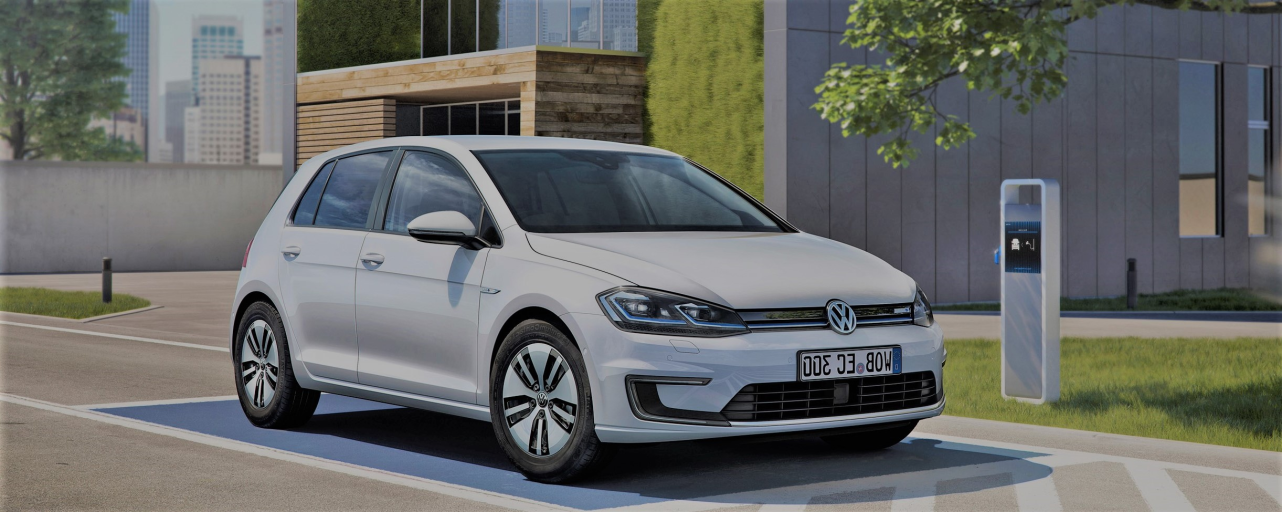
The electric Golf uses the MQB platform of the Golf VII family. It retains the familiar layout of a compact hatchback, with the traction battery integrated into the vehicle structure. The 2017 update matters for more than appearance: battery capacity increased from 24.2 to 35.8 kWh. The latter is commonly searched for as Volkswagen e-Golf 36 kWh. The number “36” is a rounded description, not another separate battery option.
Volkswagen specified a 7.2 kW onboard AC charger for the US-market 2017 e-Golf, with a full charge taking under six hours at a suitable 240 V station. Earlier cars and other markets can have different equipment. Source: Volkswagen of America on the 2017 e-Golf update.
Before buying a used car, check the VIN, model year, actual inlet and equipment list. First registration is not necessarily the model year. Verify DC charging separately: being an electric vehicle does not automatically mean the car has the fast-charging option.
e-Golf charging connectors: Type 2, Type 1 and CCS
AC charging sends alternating current through the car's onboard converter. DC charging supplies direct current from a fast charger to the traction battery under its battery management system's control. These are different charging paths: the onboard AC charger's limit does not restrict CCS charging to the same 7.2 kW.
| Original market | AC connection | DC if equipped |
|---|---|---|
| Europe | Type 2 | CCS Combo 2 |
| United States | Type 1 / SAE J1772 | CCS Combo 1 |
On a combined inlet, the two large lower contacts are for DC, while the upper section is used for AC. These are not “separate sockets for 120/240 V and 7.2 kW”: voltage, connector type and power describe different things. The US J1772 and Combo 1 connections are listed in Volkswagen's e-Golf quick-start guide.
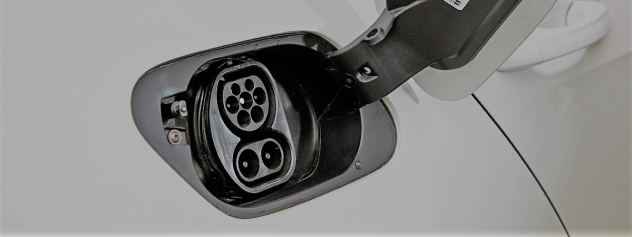
A European car at a socket-only AC station needs a suitable Type 2 cable. A US import needs Type 1 compatibility at the vehicle end. A passive adapter cannot add missing DC charging hardware or turn AC charging into fast charging. Check any proposed DC adapter with its manufacturer and the charging operator before relying on it.
How long does it take to charge a VW e-Golf?
Always compare the same starting and finishing battery levels. A full 0–100% charge cannot be compared directly with a session ending at 80%. For everyday use, the more useful question is how much energy you need to replace after your journey, rather than how long an empty battery takes to fill.
| 35.8 kWh example | Reference time | Condition |
|---|---|---|
| Household outlet with suitable EVSE | About 17 hours to 100% | Example from VW's German brochure |
| 3.6 kW wallbox | 10 hours 50 minutes to 100% | VW reference for the European model |
| Compatible AC supply up to 7.2 kW | Approximately 5–6 hours to 100% | Vehicle, supply and cable support the required power |
| 40 kW DC station | About 45 minutes to 80% | Car equipped with CCS |
These reference figures come from the German e-Golf brochure and Volkswagen's 2019 technical overview. They are not guaranteed session times. Temperature, state of charge, vehicle limits and shared station power can change the result.
The early 24.2 kWh e-Golf has different reference times. Volkswagen described roughly 13 hours at 2.3 kW, eight hours with a 3.6 kW wallbox and around 30 minutes to 80% using the optional 40 kW CCS connection. Do not transfer that 30-minute figure automatically to the larger battery. Source: Volkswagen's 2014 charging concept.
Why does an 11 or 22 kW station charge more slowly?
Actual AC power is set by the lowest limit in the chain: electrical supply, station, cable or onboard charger. The number of supported phases also matters. A Type 2 connector alone does not mean that a car uses all three phases or accepts the station's full 22 kW. Before buying a wallbox, have the charging configuration of your particular e-Golf checked against its documentation and a trial charging session.
If the car unexpectedly charges slowly, check its current limit and charging schedule, the cable rating, available station power and vehicle messages. DC power normally falls as the battery reaches a high state of charge. Once you have enough energy for the next leg, continuing the journey may be more practical than waiting for 100%.
e-Golf 36 kWh range in summer and winter
There is no single reliable range figure for every e-Golf. Volkswagen quoted 170–230 km in real driving situations for the later model in its 2019 material. That is a reference for the vehicle at the time, not a promise for an individual used car today. The old 300 km headline from promotional descriptions should not be treated as guaranteed winter or motorway range.
For personal planning, use available energy in kWh ÷ expected consumption in kWh/100 km × 100. A hypothetical 30 kWh gives 200 km at 15 kWh/100 km, about 167 km at 18, or 136 km at 22. This is an arithmetic example, not a measured e-Golf usable capacity or a road test. Keep a reserve for diversions and an unavailable charger.
In winter, heating and a cold battery increase energy needs. At motorway speeds, wind and aerodynamic resistance become more important. Check whether the specific car has a heat pump. Subtracting a fixed “20 km for heating” or “7 km for the windscreen” cannot describe every combination of weather and journey length.
A lower dashboard estimate after cold weather does not, by itself, prove battery wear. Before buying, assess e-Golf battery condition using SOH and diagnostic checks, then compare it with actual consumption on a familiar route. A predicted distance and a battery health measurement answer different questions.
Eco, Eco+ and regenerative braking
Economy modes alter the vehicle's response and climate-control operation, but they do not add a fixed number of kilometres. Regenerative braking recovers some energy during slowing and downhill travel. It does not create energy, so claiming that ordinary driving restores “40 km of range in 3 km” is incorrect. Anticipating traffic and avoiding unnecessary acceleration and braking matter more than constantly choosing the strongest regeneration setting.
Choosing an e-Golf charger for home and travel
- Identify the vehicle. Record its year, battery version, original market, inlet photo and AC limits.
- Check the installation. An electrician should assess available power, earthing, protection and circuit condition. Do not use household multiway adapters or improvised extension leads for charging.
- Calculate your overnight need. If you need to replace a hypothetical 12 kWh at an actual 3.6 kW, the theoretical time is three hours 20 minutes before losses. Maximum charging power is not always necessary for this routine.
- Match the equipment. Browse EV chargers selected for Volkswagen e-Golf and confirm compatibility with the individual car.
For a station without an attached lead, compare charging cables by vehicle connector and electrical rating. Check both ends, rated current, supported phases and length. A Type 2 cable can be single-phase: the connector shape alone does not establish whether it supports the maximum AC rate of a particular European e-Golf. A car with Type 1 requires the appropriate vehicle-end connector instead.
Before travelling in Ukraine, find charging stops for an e-Golf journey and check the connector, availability, access conditions and tariff. Identify a backup stop as well. Tesla Supercharger is not a separate, universally compatible “charging standard”: access depends on the individual station, whether it is open to other brands and compatibility with the vehicle inlet.
Calculate a session's cost from the energy billed by the meter or app, the applicable tariff and any additional fees. It is not simply the battery's nominal 35.8 kWh multiplied by an electricity price. You often start with a partly charged battery, and charging involves conversion losses. Compare the amount you actually pay with the distance covered between charges if you want a useful cost-per-kilometre figure.
Motor specifications: kW is not kWh
For the updated European e-Golf, Volkswagen specified a 100 kW motor, 290 Nm of torque, 0–100 km/h in 9.6 seconds and a top speed of 150 km/h. The 35.8 kWh figure describes battery energy capacity, not motor power. Energy consumption is expressed in kWh/100 km, not kW/100 km.
Performance, hatchback practicality and urban convenience remain part of the choice. For daily ownership, however, a checked battery and dependable charging location matter more than an advertised maximum range. Verify the figures in this article against the documentation for the individual vehicle rather than assuming all e-Golf versions have identical equipment.
Frequently Asked Questions
Are the 35.8 and 36 kWh e-Golf different versions?
In ordinary listings, they describe the same larger battery: 36 kWh is a rounded form of 35.8. Do not confuse it with the early 24.2 kWh version.
Can I charge an e-Golf from a household outlet?
Yes, using a compatible portable EVSE on a circuit checked by an electrician. The socket, wiring, protection and equipment instructions determine the permitted current, not the charging time you would prefer.
Why can a fast charger supply more than 7.2 kW?
The 7.2 kW figure applies to the relevant onboard AC charger. CCS uses a separate DC charging path and can therefore operate at higher power when the vehicle supports it.
Will an e-Golf cover 200 km on one charge in winter?
That cannot be guaranteed without knowing battery condition, temperature, speed and consumption. Plan from your own driving data and allow an intermediate charging stop instead of relying only on the dashboard estimate.
You may also like...
-
Innovations in charging technologies KIA Soul EV specifications: a detailed review of the electric car for Ukraine

-
Innovations in charging technologies Powering your home from an electric vehicle: V2H, V2G and V2L - how does it work?
-
Innovations in charging technologies Tesla Model X Specifications: Full Review of the Premium Electric Crossover