Where to charge an electric car in Kyiv?
Updated September 17, 2026.
To charge an electric car in Kyiv, choose a station with a compatible connector on the map, then check the required port’s status, tariff and parking access. The nearest marker is not always the most convenient option: your route, parking time and vehicle capabilities matter. This guide helps drivers find a charging point and estimate costs before starting a session.
Find addresses on the current map, check the price for the specific station in the app, and estimate charging time using actual power. Choose a backup point before travelling. This article is not a list of guaranteed available stations and does not set a single tariff for all of Kyiv.
Charging station addresses in Kyiv: finding the right location
Open the TOKA charging map for Kyiv. The city page offers connector-type and power filters. If you initially see a placeholder, press the button to load the map. You can also use the app to search by address and check online port status.
When searching around Pozniaky, Osokorky, Troieshchyna, Obolon, Pechersk or the city centre, consider more than straight-line distance. Check the actual approach, the relevant bank of the Dnipro, the entrance to the site and the charger’s position within the car park. These district names are search references, not confirmation that a particular point is operating.
For a trip to the suburbs, search for the specific settlement, such as Sofiivska Borshchahivka or Petropavlivska Borshchahivka. An address near Kyiv may still be inconvenient from your district. An old street list may not reflect changes to names, equipment or access arrangements, so use the current location details to plan your route.
- Check the address and exact entrance, not just the shopping centre’s name.
- Make sure your required connector is available at that particular station.
- Check port status, access hours and any parking charges.
- Review the tariff and idle-fee conditions before starting.
- Save an alternative point that you can reach with your remaining charge.
Online status helps with planning but does not reserve a space. A port may become occupied while you are travelling. If a station does not appear or its details are unclear, check the app and contact support rather than relying on an old address in an article.
Charging options: a socket, an AC station or fast DC
Your choice depends on how long the car will be parked and the charging power it supports. AC may suit a longer stay; compatible DC may suit a shorter stop. The label “fast charging” does not promise the same result for every vehicle.
- A household socket: use only with compatible portable EVSE after a qualified professional has checked the electrical installation. This does not mean you can plug into any outlet in a car park.
- A single-phase AC station: an option for home, work or longer parking. Actual power is limited by the station, electrical connection and the car’s onboard charger.
- A three-phase AC station: it can provide more power if both the vehicle and electrical installation support the corresponding mode. It does not automatically speed up every car.
- A public DC station: it supplies direct current for charging the traction battery. Your vehicle must support DC charging and have a compatible connection.
The US Department of Energy’s AFDC charging guide explains that charging time depends on starting charge, battery capacity and type, vehicle capability and equipment. A claim such as “80% in 30 minutes”, without a vehicle model and conditions, is therefore not a reliable plan for every journey.
Estimating the length of a charging stop
Approximate time = energy required ÷ average actual power. If you need to add 20 kWh to the battery and the average power actually charging it is 40 kW, the arithmetic gives 0.5 hours. This is an illustrative example, not a station promise: allow for changing power during the session and time spent connecting.
Do not divide the required energy only by the maximum kW advertised for the station. A cold battery, high state of charge, vehicle limits or power sharing between ports may make the stop longer.
Which connector should you choose?
Check the manual and actual inlet for your vehicle version. The same model sold in different markets can have different charging connections. Do not judge compatibility only by the brand, country of origin or the word “universal” in a station description.
- Type 1 and Type 2 are AC connections; the cable must match both sides of the connection.
- CCS1, CCS2 and CHAdeMO are different DC interfaces. Equal station power does not make their connectors interchangeable.
- Distinguish GB/T AC from GB/T DC and select the type supported by the vehicle.
You may need your own cable at a socketed AC point. At a station with an attached cable, check its connector. Owning an adapter does not by itself establish compatibility. Check approved use in the vehicle and equipment documentation, and do not use homemade connections.
How much does charging an electric car in Kyiv cost?
TOKA pricing depends on the station type and location. The current tariff appears on the specific station’s page in the app, and electricity is billed according to actual consumption in kWh. An idle fee may apply after the session ends, depending on the location’s terms. These rules are explained in TOKA’s answers about tariffs, idle fees and starting a session.
To estimate the electricity component, multiply the session’s kWh by the price per kWh. For example, 24 kWh at an assumed price of UAH 15/kWh would cost UAH 360. This is only a mathematical example: UAH 15 is not presented as TOKA’s current tariff or an average price for Kyiv.
Parking and idle charges may add to the total where the location’s terms provide for them. Battery capacity is not automatically the amount of energy billed for every session: you may charge only part of the battery, while losses and auxiliary systems affect consumption. Use the session data rather than a universal “full tank” price.
Do not assume that every public charger is cheaper at night. A household two-zone electricity tariff is not the tariff for a public station. If a location offers time-dependent terms, check them before starting; an old advertised price does not confirm a current offer.
Starting and finishing a TOKA charging session
Download the TOKA app for finding stations and managing charging. Its official page describes address or location-name search, filters, online port status, route planning and session control. Before travelling, check that you can access your account and review your balance.
- Find the location and check the connector, status, tariff and access conditions.
- On arrival, confirm the station number and required port. Inspect the cable and connector; contact support if there is damage or an error.
- Connect the car and follow the station and app instructions to start charging.
- Make sure the session has actually started by checking the charging status in the car or app.
- Once you have added the energy you need, end the session, wait for unlocking, disconnect as instructed and free the space.
An RFID card is an alternative way to start charging, not a requirement for every app user. Automatic starting requires a supported and configured feature. Do not assume every station starts charging as soon as you insert the connector.
Choosing charging for everyday driving in Kyiv
For a short stop, compare compatible DC points on your route by price and the charging speed your car can actually achieve. AC may be enough for several hours near the office or while running errands. If a public station is occupied, having a backup and enough remaining charge matters more than searching for the lowest price at the last minute.
If you have your own parking space, consider equipment for charging at your own parking space. For a car with the corresponding AC inlet, you can also compare charger models with a Type 2 connection. Selection requires checking the vehicle, electrical installation and installation conditions—not just choosing the highest power rating.
For more on sockets, electrical checks and apartment options, see how to arrange charging at home or in a garage. For today’s journey, start with the city map and check the specific port.
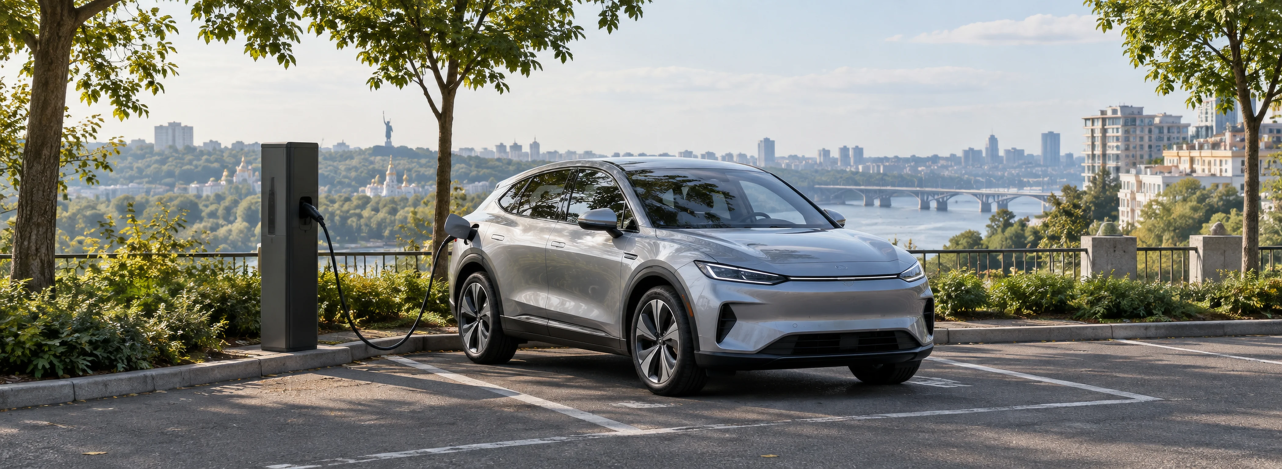
The cover is an AI-generated illustration of urban charging, not a photograph of a specific TOKA station.
Frequently Asked Questions
Can I find free EV charging in Kyiv?
Do not assume a station is free because it is next to a shop or previously ran a promotion. Check the current charging price, access conditions and parking charges. This article does not confirm any free location.
Why is a 120 kW station charging my car more slowly?
120 kW describes equipment capability under suitable conditions, not guaranteed power for every session. The vehicle, battery temperature and state of charge, and station load can limit charging speed. Compare the displayed figures with your model’s capabilities.
Does an available port mean the space is reserved?
No. A displayed status does not confirm a reservation. Conditions may change before you arrive, so check again and keep an alternative option available.
Can I leave the car after charging finishes?
Check the parking rules and idle-fee conditions for that location. Additional fees may apply after the session ends. To avoid blocking the port for other drivers, free the charging space once the car is disconnected.