How Many kW Are Needed to Charge an EV: Formulas and Power Choice
Updated September 10, 2026.
Short answer: charging an EV does not require one fixed number of kilowatts. Kilowatts (kW) describe charging speed, while kilowatt-hours (kWh) describe the energy your battery needs. For typical home use, 7.4 kW or 11 kW AC is often sufficient, but the right choice depends on the car, the electrical supply and the installation.
kW vs kWh: the key difference
kW is power: the rate at which energy moves. kWh is energy: the battery capacity and the electricity consumed from the grid. A 60 kWh battery does not need a 60 kW charger. It can charge at lower or higher power if the car supports it and the electrical installation is designed safely.
How much electricity does an EV need?
Use this formula: battery capacity × the share you need to add. Raising a 60 kWh battery from 20% to 80% adds about 36 kWh to the battery. The meter will show a little more because of charging losses in the car, cable and equipment. Allow a modest margin for planning, then use station or meter readings for the real figure.
| Example | Into the battery | Grid-energy guide* |
|---|---|---|
| 40 kWh, 20→80% | 24 kWh | about 26–28 kWh |
| 60 kWh, 20→80% | 36 kWh | about 39–41 kWh |
| 80 kWh, 10→80% | 56 kWh | about 61–64 kWh |
*Actual losses vary with temperature, equipment and charging conditions.
How to calculate charging time
A practical formula is kWh to add ÷ actual charging power in kW. Adding 36 kWh at a real 7 kW takes roughly five hours, plus losses and any reduction in power. Do not automatically divide battery size by the number printed on the station: the car may limit AC input and a station can share power between connectors.
| Actual AC power | 36 kWh into battery | Typical use |
|---|---|---|
| 2.3 kW | about 16–18 hours | slow top-up |
| 3.7 kW | about 10–11 hours | overnight charging |
| 7.4 kW | about 5–6 hours | typical home use |
| 11 kW | about 3.5–4.5 hours | three-phase supply and compatible car |
| 22 kW | not every car accepts it | only with vehicle and supply support |
Choosing home charging power
Start with daily driving, not the largest number. If the car uses 15–25 kWh a day and sits for 8–10 hours overnight, 3.7 kW can be enough. 7.4 kW provides more margin for many single-phase homes. 11 kW makes sense with three-phase supply, adequate capacity and a car that accepts it. A 22 kW station does not make a 7.4 or 11 kW-limited car charge faster.
Check the exact vehicle’s AC input rating, port type, available supply capacity and concurrent loads from a boiler, cooker or heat pump. Find compatible equipment in the TOKA catalogue.
Single-phase and three-phase supply
Single-phase systems are commonly used for 2.3–7.4 kW, while three-phase supply enables 11 or 22 kW. That does not mean every household needs three phases: a safe 7.4 kW point can cover daily needs. Cable condition, breakers, residual-current protection, grounding, load balancing and contracted capacity all matter. A qualified electrician should inspect the panel and line before installation.
AC vs DC charging
With AC charging, the car’s onboard charger converts the current and often limits the power. With DC charging, conversion happens in the station, so power can be higher but varies with battery temperature, state of charge, vehicle model and station capability. DC is principally useful on a journey; home AC charging is usually more predictable for daily use.
Safe installation at home
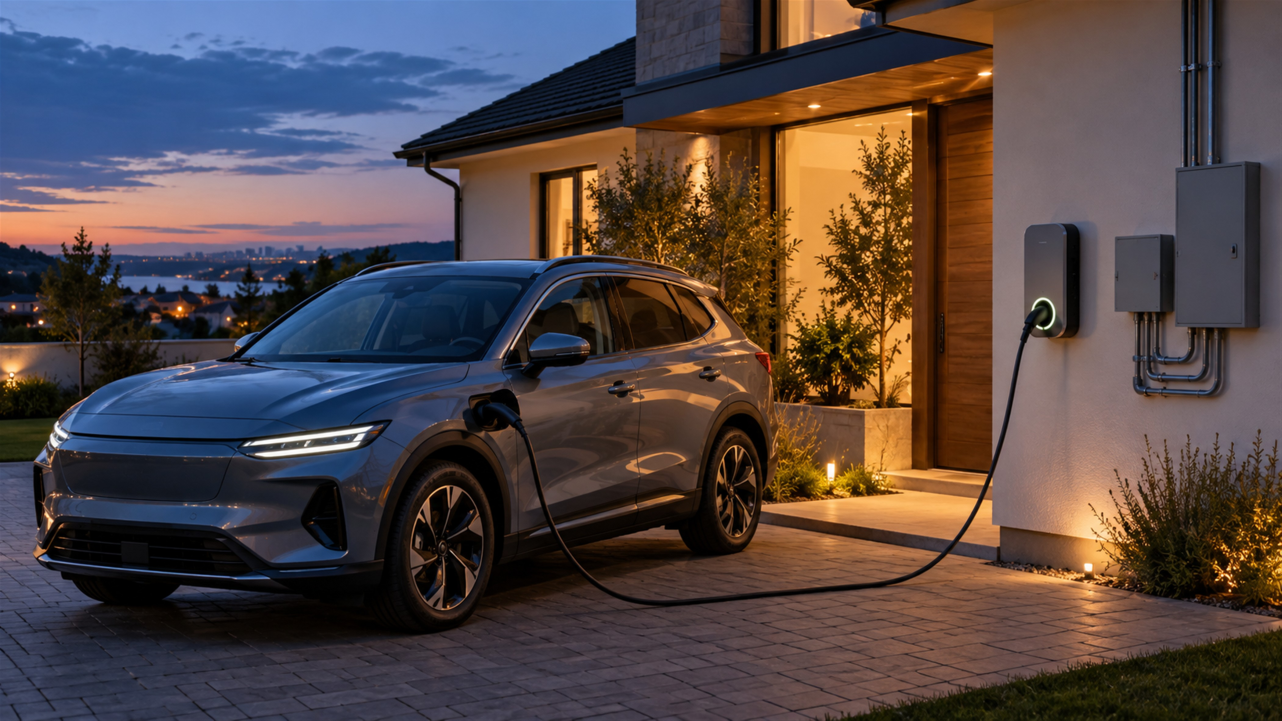
Do not use random extension leads, sockets that show heating or a circuit already serving other high-load appliances. A fixed charging point needs correctly sized cable, protective devices, leakage-current protection and reliable grounding. After installation, run a monitored session and check for errors, hot contacts and stable charging. If a session repeatedly stops, do not increase current—stop and ask a qualified specialist to assess it.
Planning public charging
On a route, station power is only one factor. Connector compatibility, availability, current state of charge and a reserve to the next location matter too. Check the TOKA charging map before departure. Do not reach a DC charger with no reserve; it lets you change plans if the station is occupied or a session will not start. For imported ports, verify the adapter and the exact charging point in advance.
FAQ
How many kilowatts are needed for home EV charging?
For most daily use, 3.7–7.4 kW AC is enough. Choose 11 kW when the supply, installation and vehicle all support it.
How many kWh does a full charge use?
Use battery capacity plus charging losses. A 60 kWh battery takes a little more than 60 kWh from the grid for a full charge.
Can I charge from a normal socket?
Only when the socket and entire circuit have been checked for continuous load. A dedicated circuit and compatible equipment are safer for regular charging.
You may also like...
-
Innovations in charging technologies EV Battery Degradation: SOH, Cell Imbalance and Health Checks


-
Innovations in charging technologies KIA Soul EV specifications: a detailed review of the electric car for Ukraine
-
Innovations in charging technologies TOP-13 electric crossovers: a review of production models