Does Tyre Size Affect EV Range and Power Consumption?
Updated November 3, 2026.
Wheel and tyre size can affect an electric car's range and power consumption through rolling resistance, aerodynamics and the mass of the wheel-and-tyre package. The result depends on the specific tyre, wheel, vehicle and driving conditions. A smaller manufacturer-approved wheel can often be more efficient, but there is no universal 8%, 15% or 23% range gain for every EV. Start with approved fitments and safe grip, then compare efficiency.
How do tyres influence EV range and energy consumption?
A rolling tyre deforms and dissipates some energy. Construction, compound, pressure, load and temperature affect those losses. Tread design matters too, but simply choosing the hardest, smoothest rubber is not sound road-car advice. Suitable grip, water clearance and seasonal performance are essential. Low energy use does not compensate for unsuitable traction or an incorrect load rating.
The European Commission's explanation of tyre properties covers rolling resistance, wet grip and external noise. Compare those characteristics together in the size you need. A good efficiency class does not remove the vehicle's load and speed requirements. An EV label alone also does not identify the best tyre for every car, operating condition or season.
Wheel diameter, tyre width and aspect ratio are different
In 205/55 R16, 205 is the nominal width in millimetres, 55 is sidewall height as a percentage of width, R denotes radial construction, and 16 is the wheel's rim diameter in inches. Therefore, 55 does not mean a 55 mm sidewall. In this illustrative example, sidewall height is 205×0.55=112.75 mm. This explains a marking; it is not a recommended fitment for your EV.
The rim diameter is not the outside diameter of the complete tyre. A larger wheel is often paired with a lower sidewall. Do not arbitrarily change overall size, width, offset or load capability: fitment, brake clearance and vehicle systems matter. The smallest wheel that can physically be installed is not necessarily an approved or suitable package.
A wider tyre can change losses and aerodynamics, but the difference in millimetres alone is insufficient to predict range. Two tyres of the same size can also have different constructions and efficiency. Compare particular products instead of assuming that a width change always adds exactly one percent to consumption. The tyre's suitability for the car and conditions comes before an assumed range benefit.
Why do electric cars have large wheels?
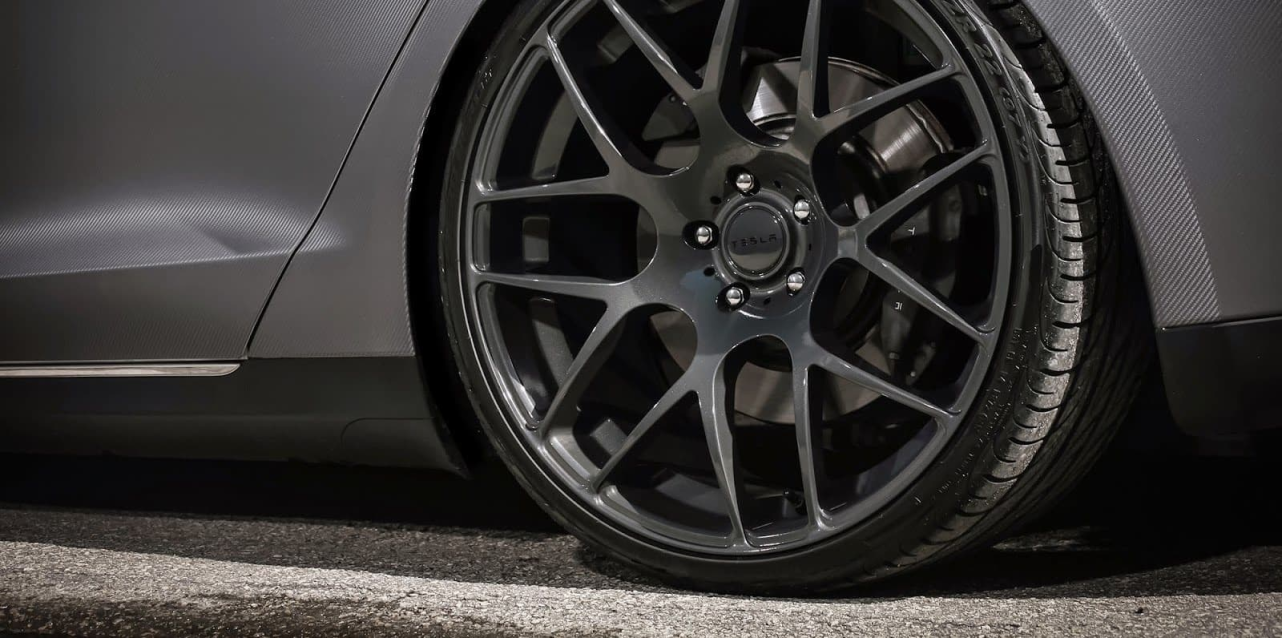
Wheel choice reflects design, the required tyre package, brake clearance and other vehicle requirements as well as efficiency. Large wheels are not necessary on every electric car simply because it is electric. A change in rim size may be accompanied by changes in width, compound, mass or aerodynamic design, so the resulting consumption difference cannot automatically be attributed to diameter alone.
Energy is needed to accelerate the vehicle's mass and its rotating wheel assemblies. However, a larger wheel is not necessarily heavier than every smaller one: material, construction and the fitted tyre all matter. Spoke shape and aerodynamic covers can also affect airflow. Assess the complete approved package, including comfort, grip and replacement cost.
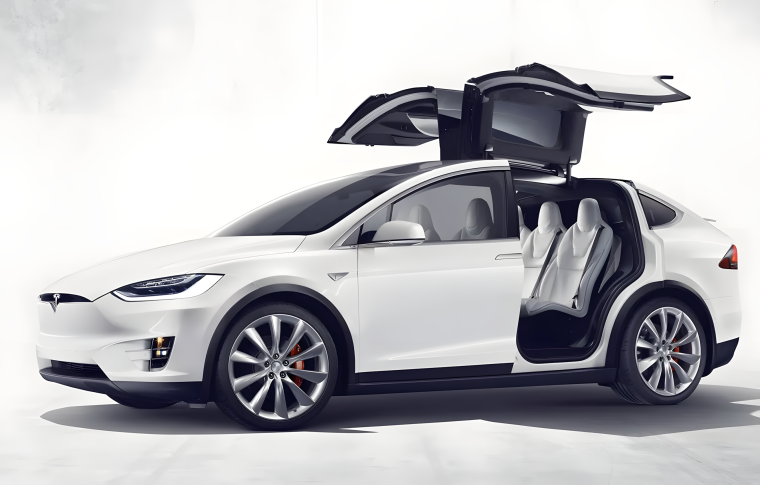
Percentages from old Tesla Model 3, Model S, Model X or Hyundai Kona Electric comparisons should not be transferred to every model year. A meaningful comparison needs equivalent battery, drivetrain, tyres, method and conditions. If several aspects change together, report the package difference rather than claiming a universal effect from the wheel size alone.
Maintain the correct cold tyre pressure

Generated illustration of a tyre-pressure check. It does not show a measured value or a test of a particular model.
Underinflation increases deformation and can compromise efficiency and safety. Use the vehicle's label and manual for the approved package, accounting for load. The maximum pressure on a tyre's sidewall is not automatically the recommended operating pressure. Check the actual requirements rather than borrowing a pressure value from another EV with similar-looking wheels.
Tesla's tyre-care instructions explain checking a cold set and warn against releasing air from a warm tyre to match a cold-pressure target. Use the instructions and values for your own vehicle. Inflating beyond the recommendation to chase an assumed range gain is not a substitute for selecting and maintaining suitable tyres.
How to assess a change in range
Divide available energy by consumption and multiply by 100. An illustrative 60 kWh at 18 kWh/100 km corresponds to about 333 km without a reserve; at 19 kWh/100 km, it is approximately 316 km. This is arithmetic, not a measured effect of replacing wheels. The actual consumption change for your package must be established separately.
Compare journeys with similar speed, temperature, wind, route, load and tyre pressure. A short trip after fitting new tyres does not isolate their effect from the weather. Laboratory tests and road measurements have different conditions; it is incorrect to claim that all research is performed only on a test rig. Dashboard predictions also adapt to previous driving, so a changed estimate alone is not a controlled efficiency test.
Energy-efficient tyres and electricity-generating concepts
A normal energy-efficient tyre reduces losses; it does not recharge the traction battery from sunlight. In 2015, Goodyear presented its BHO3 concept, exploring conversion of heat into electricity. That concept should not be presented as a feature of ordinary production tyres sold for low rolling resistance. Reducing energy demand and generating electrical energy are different ideas.
Season and weather affect more than the wheels. The guide to using an electric car through winter also addresses consumption and journey preparation. After changing a wheel-and-tyre package, update the energy reserve to an alternative location on the TOKA map for planning charging stops. Use actual consumption rather than an old range promise when deciding how far to travel before plugging in.
Frequently asked questions
Does changing tyre size affect power consumption?
It can, but the direction and amount cannot be inferred from dimensions alone. Compare manufacturer-approved packages with equivalent conditions, taking tyre construction, mass and aerodynamics into account. A general article cannot establish a model-specific percentage without suitable evidence.
Does an aspect ratio of 45 mean 45 mm?
No. It is sidewall height as a percentage of nominal tyre width. The width is also needed to calculate the illustrative height.
Can I increase pressure to gain range?
Maintain the manufacturer's values for your fitment and load. Overinflation in pursuit of range does not replace correct tyre selection and maintenance.