Fiat 500e: Fiat 500e Electric Car Charging Key Specifications and Features
Updated September 17, 2026.
Choose a Fiat 500e charger by the car’s generation and original market. The first US-market 500e has a 24 kWh battery, a Type 1 / SAE J1772 inlet and a 6.6 kW onboard AC charger, without factory DC fast charging. The European New 500 with a 23.8 or 42 kWh battery is a different EV: it supports Type 2, AC charging up to 11 kW and CCS Combo 2 for DC. A listing labelled “Fiat 500 electric” is therefore not enough to select a cable or charging station.
In brief: check the VIN, model year, battery and a photograph of the charging inlet, then check the power available at your parking space. This guide separates the specifications, explains charging times and lists the checks needed before connecting an imported car in Ukraine.
Short description: which Fiat 500 electric do you have?
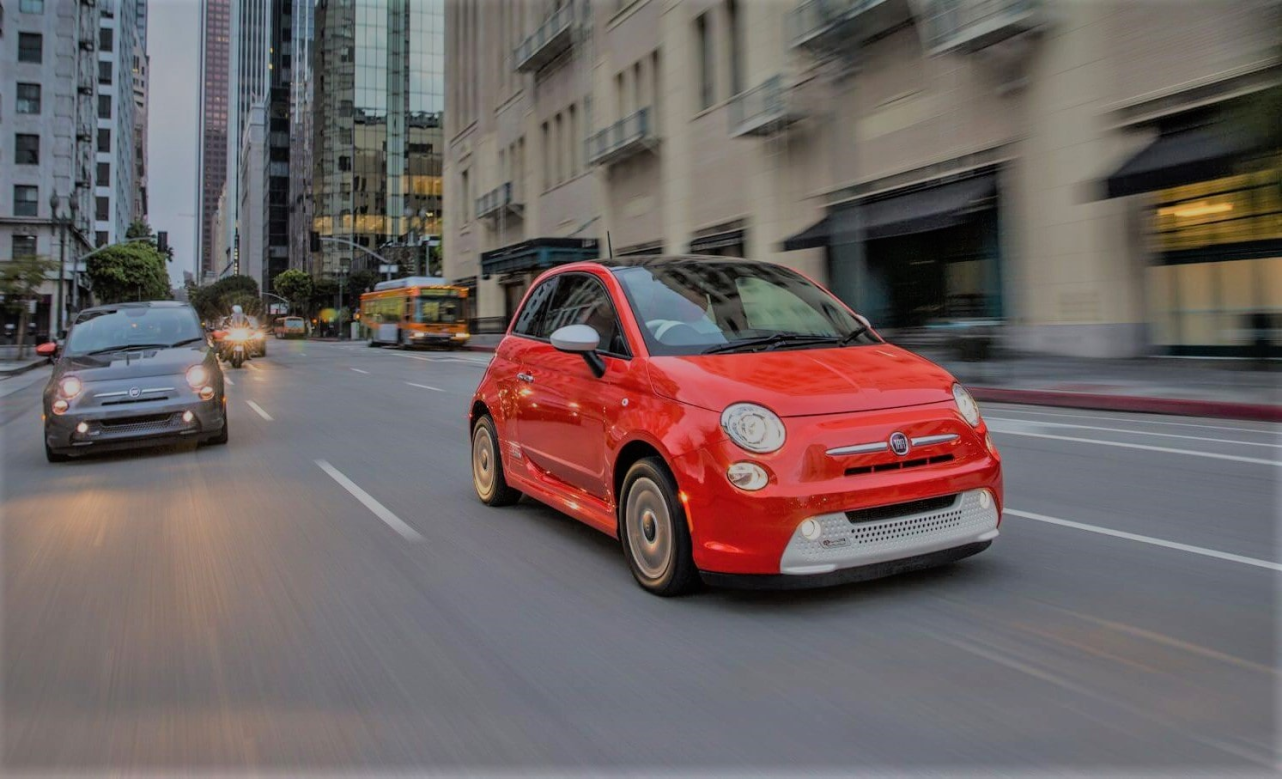
The original Fiat 500e reached the US market as a 2013 model. It uses the earlier Fiat 500 body and therefore resembles the petrol hatchback. The New 500 introduced in 2020 uses a different electric platform. Treating them as one generation and transferring charging specifications between them can lead to buying incompatible equipment. Later US imports also require a separate inlet check: European specifications are not universal.
Both are compact four-seat cars, but everyday practicality is about more than dimensions. Check rear-seat access, luggage space and the distance between your parking position and the supply point. A battery mounted low in the body is not immune to damage; an underbody inspection remains part of checking a used vehicle.
Fiat 500e specifications: battery size, dimensions and weight
For the original model, use the factory specifications for the 2017 Fiat 500e (PDF) as a model-year-specific reference, not a specification for every car carrying the 500e name:
- Battery: 24 kWh lithium-ion, with liquid cooling and heating; motor: 83 kW and 200 Nm.
- Front-wheel drive and a single-speed reduction gearbox; MacPherson front suspension, a rear twist-beam axle and disc brakes.
- Dimensions: 3,617 × 1,627 × 1,527 mm; turning diameter: 9.54 m; listed curb weight: 1,355 kg.
- Luggage capacity: approximately 199 litres under the stated EPA method; standard tyres: 185/55 R15. Check your vehicle’s label for the applicable tyre specification and pressure.
For the European New 500, the manufacturer lists 23.8/42 kWh batteries, 70/87 kW motors, dimensions of 3,632 × 1,683 × 1,527 mm excluding mirrors and a 185–550-litre luggage compartment. The technical sheet lists DIN kerb weights of 1,255/1,365 kg and maximum payloads of 380/400 kg including the driver for the hatchback versions. Weight conventions differ: use the specific car’s documents for passenger and luggage limits rather than subtracting two figures from an advertisement.
Fiat 500e top speed and acceleration also depend on the version. The 2017 sheet gives an estimated 141 km/h; the New 500 sheet lists 135/150 km/h and 0–100 km/h in 9.5/9 seconds respectively. These are performance specifications, not recommended driving speeds. There is no universal “safe speed of 72 km/h” for this model.
Driving range and electricity consumption
The US-market 2017 Fiat 500e has an EPA combined range rating of 87 miles, or approximately 140 km. The European New 500 has different reference figures: around 190 km WLTP for the smaller battery and around 320 km for certain 42 kWh versions. These come from different test cycles and are not a direct comparison of winter driving range.
On the road, speed, temperature, wind, gradients, cabin heating, tyres and battery condition affect range. Regenerative braking recovers some energy during deceleration; it does not eliminate the energy needed to drive. For a used car, assess battery condition and actual consumption rather than relying only on the dashboard estimate after charging.
Battery capacity is measured in kWh, consumption in kWh/100 km, and charging power in kW. A figure of “29 kWh” without a distance does not describe consumption. Likewise, the MPGe petrol-equivalent rating does not mean the EV burns petrol. Do not plan on another 3–5 km after the display reaches zero: that is not a guaranteed reserve, and low charge can bring reduced power.
Fiat 500e charging time: household socket versus charging station
For the original US 500e, the manufacturer gives approximately four hours on suitable 240 V AC charging equipment. That does not mean a full charge takes four hours from a 220 V / 12 A household supply. Such a supply provides only 220 × 12 ÷ 1,000 = 2.64 kW, theoretically delivering 10.56 kWh in four hours before charging losses.
For a planning example, suppose you need to add 12 kWh to the battery. Dividing by 2.64 kW gives about 4.5 hours; dividing by 6.6 kW gives about 1.8 hours. These are idealised calculations, not promised charging times. Losses, temperature management, vehicle limits and the final charging stage affect the real session.
For the New 500, the official European technical sheet lists approximately 2 hours 30 minutes / 4 hours 15 minutes on 11 kW AC for the 23.8/42 kWh batteries. Listed DC times to 80% are around 30 minutes at a maximum 50 kW / 35 minutes at a maximum 85 kW. Fiat’s official web article on New 500 charging also confirms 50 kW DC for Action and 85 kW with charging to 80% in 35 minutes for Passion. These are specification conditions: peak power is not maintained throughout a session, and a 0–80% charge is not a full charge.
An original US portable charging unit may be rated for 120 V. Do not connect it to a Ukrainian supply using a simple plug adapter without checking its permitted input voltage. The 2017 Fiat 500e owner’s manual (PDF) requires proper grounding and prohibits an extension cord with the original portable unit. Have a qualified electrician check the circuit, protection and permitted continuous current.
Fiat 500e charging ports: Type 1, Type 2 and CCS
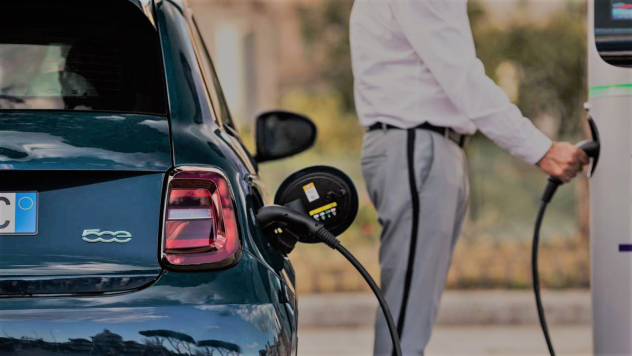
The original US 500e has its charging flap on the right rear body side, not on a door. Its Type 1 / SAE J1772 inlet takes AC. A CCS or CHAdeMO station cannot give this car DC fast charging through a simple adapter. Its 6.6 kW onboard charger is one component; a lower session power does not indicate a second charging module.
For this version, look at Type 1 charging equipment for an imported US Fiat. A socketed Type 2 AC station requires a compatible Type 2-to-Type 1 cable. When browsing AC cables for connecting your car to a socketed station, check both ends, the current rating and length. A single-phase 32 A cable can suit this use when its connectors and certification match the equipment. It is not a DC converter or a replacement for a portable EVSE connected to a household socket.
On the European New 500, the upper part of the CCS Combo 2 inlet accepts Type 2 for AC; the lower power contacts are used for DC. Select Type 2 equipment for the European Fiat 500e accordingly. Using 11 kW AC requires suitable three-phase power, a compatible cable and correct settings. A “22 kW” station label cannot make the car accept 22 kW.
Where to charge a Fiat 500e and how to choose equipment
For home or allocated parking, compare charging stations for a daily home-parking routine by connector, phase count, available power and cable length. A portable unit is useful only where a checked, compatible socket is available; it is not an independent energy source. Shared parking may also need metering, access control and power sharing between connectors.
Before travelling, check TOKA locations with a suitable charging connection, availability, tariffs and opening hours. For the original 500e, find compatible AC charging; for the New 500, choose AC or the appropriate CCS connection. The station’s total power or number of connectors is not the power one vehicle will necessarily receive.
Before ordering, send the consultant your VIN or exact model year and original market, an open-inlet photograph, supply details and required cable length. A cable, adapter, EVSE and battery management unit have different functions. The BMS is part of the vehicle’s system, not an ordinary home-charging accessory. Make the final choice by compatibility and confirm equipment and installation prices separately.
Frequently Asked Questions
Does the Fiat 500e support fast charging?
The original US 500e with a 24 kWh battery has factory AC charging only. The European New 500 supports DC through CCS Combo 2; its charging limits depend on the battery and specification.
Will one charger fit every Fiat 500 electric?
Not without checking. The older US and newer European cars have different inlets and limits. A socketed station may only need the appropriate AC cable, but that does not add DC support to a car that lacks it.
Why does a Fiat 500e charge slowly at a powerful station?
The vehicle, cable, supply and station all impose limits. Check phase availability, current ratings, settings and load sharing. If there are errors or abnormal heating, stop the session safely and seek service support.
Can I drive a few more kilometres after the battery reaches zero?
Do not rely on it. Choose a backup charging location beforehand. With critically low charge, stop somewhere safe and arrange assistance in accordance with the vehicle’s manual.
You may also like...
-
Innovations in charging technologies TOP-13 electric crossovers: a review of production models

-
Innovations in charging technologies Electric car or gas car (LPG). What is more profitable?
-
Innovations in charging technologies Electric vehicle safety: what you need to know about electric vehicle fire safety