Electric vehicle versus plug-in hybrid: choice difficulties
Updated September 25, 2026.
A battery-electric vehicle (BEV) drives on electricity alone. A plug-in hybrid electric vehicle (PHEV) combines a battery that can be charged from the grid with a combustion engine. If you can charge regularly and most journeys fit comfortably within the real-world range of the BEV you are considering, the fully electric car is often simpler to live with. If charging is intermittent or you frequently travel where reliable chargers are scarce, a PHEV can offer a useful fuel-powered backup. Its electric benefits, however, depend on actually plugging it in.
The choice is not settled by comparing two advertised range figures. Your daily distance, home or workplace parking, charging connector, actual electricity and fuel use, maintenance needs, and the price of the exact vehicle version all matter. This guide keeps those questions separate so that an attractive specification does not hide a poor fit for your routine.
HEV, PHEV, REEV, BEV and FCEV: the drivetrains explained
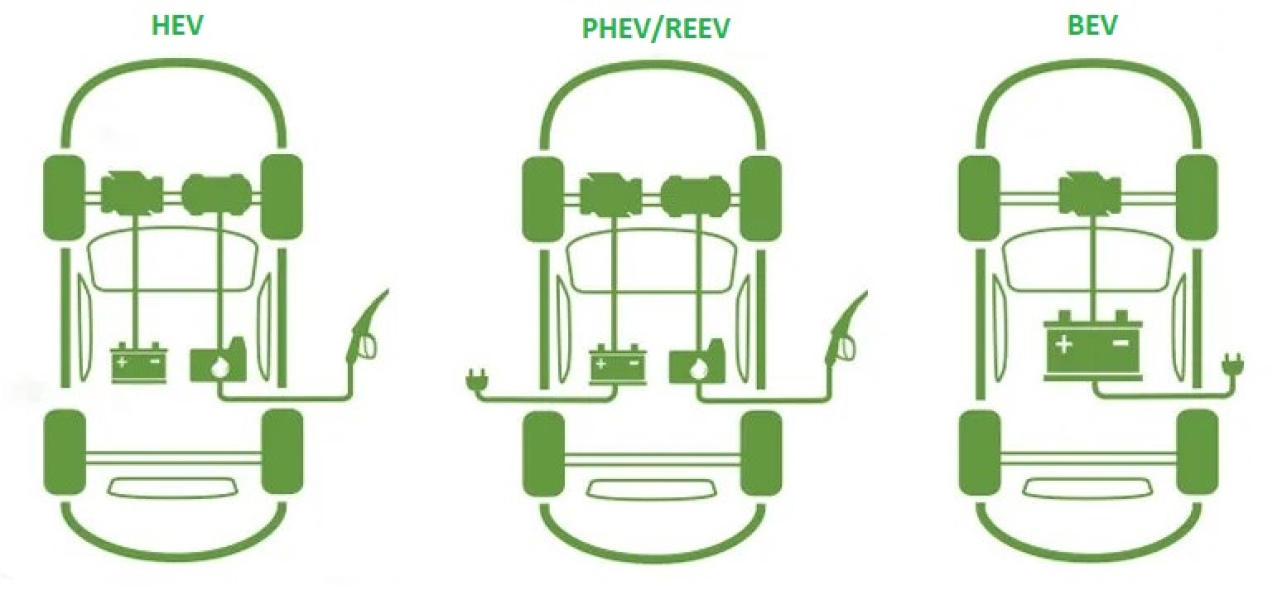
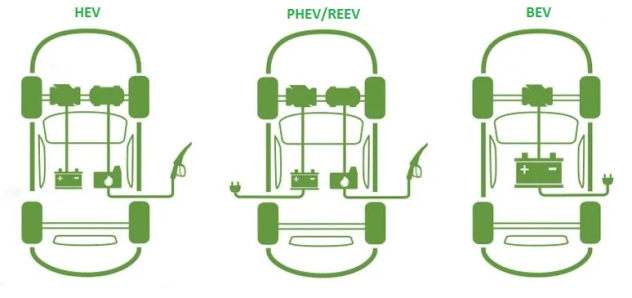
HEV means a conventional hybrid electric vehicle. It combines an internal-combustion engine with one or more electric motors and a relatively small battery. The battery gains energy mainly through regenerative braking and the engine; you do not plug the car into an external charger. “Hybrid” by itself therefore does not mean “rechargeable at a charging station.” Check the full designation of any vehicle you are considering.
PHEV means plug-in hybrid electric vehicle. It has a combustion engine and electric motor, plus a battery that accepts power from an external source. Some journeys can be completed on electricity, while the engine can take over or assist when the battery is depleted or power demand is high. The electric-only distance, how the powertrains interact, and whether fast charging is supported are model-specific features, not properties guaranteed by the letters PHEV.
REEV refers to a range-extended electric vehicle. Its wheels are typically driven by an electric motor, while a fuel-burning engine primarily generates electricity to extend the journey. Implementations vary, and some vehicles can operate in more than one mechanical mode. It is therefore misleading to describe every REEV as identical to every PHEV or to a non-plug-in HEV. Look at the technical diagram and test how the actual vehicle behaves after its battery charge has fallen.
BEV is a battery-electric vehicle without a fuel-burning engine or tailpipe. It needs external charging. Its usable driving distance depends on the battery and on speed, temperature, terrain, tyres, heating and driving style. The old claim that affordable electric cars can travel only about 130 km is no longer a useful generalisation. Compare particular model years and battery options, ideally using independent tests conducted in conditions relevant to you.
FCEV also drives with an electric motor but generates its electricity from a hydrogen fuel cell. Refuelling requires hydrogen infrastructure, not the charging arrangements used by a PHEV or BEV. It is included here to keep the terminology clear; the purchasing comparison in the rest of this guide concerns BEVs and PHEVs. The US Department of Energy’s Alternative Fuels Data Center explains the basic categories and why the terms should not be treated as interchangeable.
The plug-in habit matters more than a PHEV’s brochure range
The crucial difference between a PHEV and an HEV is access to electricity from the grid. A driver who plugs in almost daily and whose typical journey is shorter than the PHEV’s actual electric range may complete many trips without starting the combustion engine. A driver who rarely charges may see fuel use and emissions closer to a conventional hybrid of comparable size. “PHEVs are always cheaper to run” is thus an incomplete claim unless the charging pattern is described.
The advertised electric-only range is a planning estimate, not a guarantee. Cabin heating, a cold battery and winter tyres can change the result, while speed and hills matter on longer drives. Write down your normal daily distance, then compare it with independent observations for the correct model year and battery. If your day covers 45 km but your chosen PHEV manages 35 km on electricity in your conditions, the remaining section will use fuel even if you started the morning fully charged.
For a BEV, apply a similar test with a safe margin to the next working charger. On intercity routes, confirm connector compatibility, site availability and the current charging conditions in the TOKA network station finder before leaving. A pin on a map does not guarantee that a suitable connector will be free when you arrive. Also keep a fallback stop in mind when a journey depends on a single location.
Home and public charging: power, plugs and realistic timing
A BEV and a PHEV with compatible ports can both use appropriate AC charging equipment. The car’s on-board charger, however, limits the power it can accept: a 22 kW station will not make a PHEV accept 22 kW if its electronics are designed for less. Most PHEVs cannot use DC rapid chargers at all, though exceptions exist. DC charging is more common among BEVs, but its actual speed still depends on the vehicle, battery temperature, state of charge and charger. The AFDC consumer guide highlights the need to check this distinction when comparing vehicles.
Before buying, verify the particular car’s AC connector, single- or three-phase capability, maximum AC input, DC support, supplied cable and manufacturer limits. European-market cars often have a Type 2 AC connector, but imported vehicles from other markets may differ. You can browse charging equipment filtered for Type 2; treat the car and station manuals as the final compatibility check. Do not infer compatibility from a product photo alone.
Home charging can make either powertrain much more convenient if the electrical supply, protection and parking arrangement are suitable. A random extension lead should not become a permanent charging installation. If you need fixed equipment, compare home charging stations and have a qualified installer assess the circuit and load. Our separate guide to charging an electric car at home walks through time and cost calculations without assuming that every home has the same tariff or electrical capacity.
Which costs less to run? Calculate for your own journey
Use your own prices rather than a historical “average charging tariff.” For a BEV, estimate electricity cost as kilometres driven × actual kWh per 100 km ÷ 100 × the current price per kWh. For a PHEV, calculate the electric segment the same way and the combustion-engine segment as kilometres × litres per 100 km ÷ 100 × the current price per litre. Add charging losses, parking or session fees, and service costs where they apply. This is a comparison method, not a claim that a particular car will always achieve a fixed consumption figure.
For example, a BEV using 18 kWh/100 km would need about 9 kWh delivered to the vehicle for 50 km of driving. The amount drawn from the wall can be higher because charging is not perfectly efficient. If a PHEV covers 35 km on electricity and 15 km on fuel, work out the two portions separately. Repeat the calculation for cold-weather commuting and high-speed travel rather than relying on one best-case number. A PHEV used mainly without external charging may be quite different from the same car charged every night.
The purchase price is only one element of ownership. A BEV does not have combustion-engine oil, spark plugs or an exhaust system, yet it still has tyres, brakes, cooling equipment, electronics and potentially costly components. A PHEV carries both an electric system and a combustion engine, so assess the service schedule for both. Neither “an EV needs service only every 20,000–30,000 km” nor “it is serviced two or three times less often” is a safe universal statement. Compare the actual maintenance schedule, warranty and local repair options for each candidate.
Consider depreciation, battery condition and insurance as well. These depend on model, age and market, not just the powertrain label. For a used BEV, ask for a battery-health assessment and check the charging history where available. For a used PHEV, inspect both the combustion system and high-voltage components. A cheap asking price is not a bargain if the vehicle lacks the connector, warranty coverage or reliable local support your use case needs.
Long journeys, winter and everyday convenience
The PHEV’s combustion engine can keep a trip moving when you cannot charge. That reduces dependence on public charging, but it does not make range unlimited: fuel must still be available. A PHEV constantly driven with a depleted battery carries the weight of an electric drivetrain without making full use of it. Its best use is often the combination of regular plug-in commuting and occasional longer journeys for which a fuel backup is genuinely valuable.
A BEV offers quiet electric travel and no tailpipe emissions from the vehicle. It usually has a simpler propulsion layout, but long trips require a charging plan. In winter, both BEV range and charging speed may change, and the PHEV’s electric-only distance may fall as well. Build a practical reserve for your route rather than turning off necessary heating in pursuit of a theoretical range record. See our article on using an electric car in winter for the effects of battery temperature and preconditioning.
Environmental claims also need care. A vehicle is not “100% clean” across its whole life: battery production and electricity or fuel generation have impacts. A BEV produces no exhaust from a tailpipe while driving, whereas a PHEV does when its combustion engine runs. The PHEV’s real emissions depend strongly on how much it is charged and driven electrically. A meaningful comparison considers production, the energy source, use and end of life, rather than treating one city journey as the whole story.
Purchase price and Ukrainian taxes: why the 2020 figures no longer work
The previous article compared purchase prices using a VAT exemption for imported battery-electric cars. That exemption has ended. From 1 January 2026, import and supply of vehicles powered exclusively by electric motors are subject to VAT under the ordinary rules, according to the State Tax Service of Ukraine. The old suggestion that a BEV necessarily costs about 30% less than a comparable hybrid after import is not a current calculation and should not guide a purchase.
The actual bill depends on the customs value, Ukrainian tariff classification, drivetrain, excise duty, import duty, VAT, vehicle age and seller’s price. Before importing a particular car, request a current calculation based on its documents from a customs broker or qualified adviser. Do not assume that rules for an all-electric car also apply to a plug-in hybrid. For a car already registered in Ukraine, compare the full asking price with battery health, service history, warranty and charging equipment rather than trying to reverse-engineer an old tax example.
The registration counts from 2017–2020 in the original version were a historical snapshot, not a description of the market in 2026. The old proportions attributed to Tesla, Nissan and Toyota, and the number of charging points cited at the time, should not stand in for today’s availability. Inspect the models actually for sale, local service options and the charging network along the roads you use. The relevant question is not which drivetrain was more popular six years ago but which specific car you can operate confidently now.
Choosing between a BEV and a PHEV
Consider a BEV first if home, workplace or routine-route charging is dependable; your daily travel falls within the real range of the exact car; and you are willing to plan the occasional longer trip. Consider a PHEV if you can plug in most days but frequently need to travel through areas where charging is uncertain and genuinely value the fuel backup. If plugging in will almost never happen, include a regular HEV in the comparison. Paying for a PHEV’s plug-in hardware while seldom using it may not deliver the advantage you expect.
Before signing, test-drive the car on a familiar route, check actual consumption, connector and charging rate, battery warranty, and, for a PHEV, the condition of its combustion engine. Obtain a realistic home-installation estimate if that is central to the plan. Do not apply specifications from one trim or market version to another. The useful outcome is a car that works with your driving and budget, not an abstract winner of “electric versus hybrid.”
Frequently Asked Questions
Which kind of hybrid can be charged from a socket?
A PHEV can be charged from an appropriate external electricity supply. A conventional HEV cannot: its battery is replenished by regenerative braking and the engine. Confirm the designation, charging port and manual of the exact vehicle version.
Must I charge a PHEV every day?
It can drive using fuel, but regular plugging in is necessary to use much of its electric range and potential fuel savings. How often you need to charge depends on your routes, battery capacity and access to charging.
Can a plug-in hybrid use a DC rapid charger?
Most PHEVs cannot, though exceptions exist. Check the car’s port and maximum supported power in its documentation. An AC charging port by itself does not establish DC compatibility.
How does a REEV differ from a PHEV?
A REEV typically uses its fuel-burning engine mainly as a generator to extend electric driving. Some PHEV configurations can drive the wheels directly from the combustion engine. Designs overlap in practice, so the technical description of the particular model matters more than the abbreviation alone.
You may also like...
-
Innovations in charging technologies Business at charging stations for electric vehicles - Investment in electric charging stations


-
Innovations in charging technologies Design of an electric car: how does the motor work and the main components?

-
Innovations in charging technologies Where to charge an electric car in Kyiv?